Table of Contents
- Cement and concrete look interchangeable.
- Concrete Marketing struggles because buyers are screening for downside, not upside
- Marketing matters only when it reduces risk
- The B2B channels that actually influence specifications and project awards
- One concrete marketing idea that breaks the “commodity material” trap
- Summary TL;DR
Subscribe to our Newsletter and Learn B2B Marketing.
This changes quickly when something goes wrong.
Marketing tends to go unnoticed when projects seem safe, but it actually shapes which suppliers are trusted when risks appear. For decision-makers, this is important because most choices are made well before any problems reveal what was missed.
Most marketing fails here because buyers are not looking for inspiration or differentiation. They are trying to avoid blame. Engineers, spec writers, and contractors are rewarded for preventing cracks, delays, and compliance issues, not for selecting a “better” brand. As a result, anything that increases perceived uncertainty – new claims, bold sustainability promises, unfamiliar positioning – gets filtered out.
You’ll see why B2B marketing only gains influence when it reduces approval friction and execution risk, and how that changes what messages, channels, and proof actually work in this industry.
Cement and concrete look interchangeable.
Cement and concrete are usually bought as if they are all the same. This works on most projects because problems haven’t happened yet. But as soon as there’s a risk of failure, people stop focusing on price and availability and start thinking about accountability, proof, and who will be blamed if something goes wrong.
This change is not about technical curiosity but about incentives. Engineers and contractors are rewarded for avoiding problems, passing inspections, and staying on schedule. Not for finding slightly better materials. Picking a familiar option that behaves as expected feels safer than choosing something ‘better’ that could raise new questions during approval or on the job.
Several forces make this risk sensitivity sharper, not softer:
- Performance risk: Strength variability, curing behavior, or durability issues create downstream exposure.
- Delivery risk: Missed pours or inconsistent supply create cascading schedule failures.
- Compliance risk: Testing, certification, or documentation gaps can stop work outright.
Local factors make this even more important. Local delivery conditions often matter more than a brand’s reputation. Things like mix consistency, plant reliability, weather, and site support can be more important than any national brand promise once a project is underway. A big name does not help if the local operation causes uncertainty.
Sustainability adds another layer of scrutiny. As CO₂ reporting and environmental requirements increase, claims attract more attention. But also more doubt. Sustainability pressure increases scrutiny, not trust, when proof is weak. Without comparable, attachable evidence, environmental messaging feels like added approval risk rather than reassurance.
In practice, cement and concrete are only commodities when nothing is at stake. As soon as risk appears, buyers stop asking “what’s cheaper?” and start asking “what is safest to approve and defend?”
Concrete Marketing struggles because buyers are screening for downside, not upside
What to focus on here:
Why feature-led and brand-led messages get ignored
Feature lists and brand claims assume buyers want something better. In reality, buyers want permission to move forward without risk. Details like strength classes, additives, awards, and slogans don’t answer the real questions at approval time: Will this pass? Will this work as expected? Who is responsible if it doesn’t?
| Messages | Reason why it’s ignored |
|---|---|
|
“Higher performance”
|
Unproven behavior on my site
|
|
“Innovative mix”
|
New questions during approval
|
|
“Leading brand”
|
Not relevant to local delivery risk
|
Marketing matters only when it reduces risk
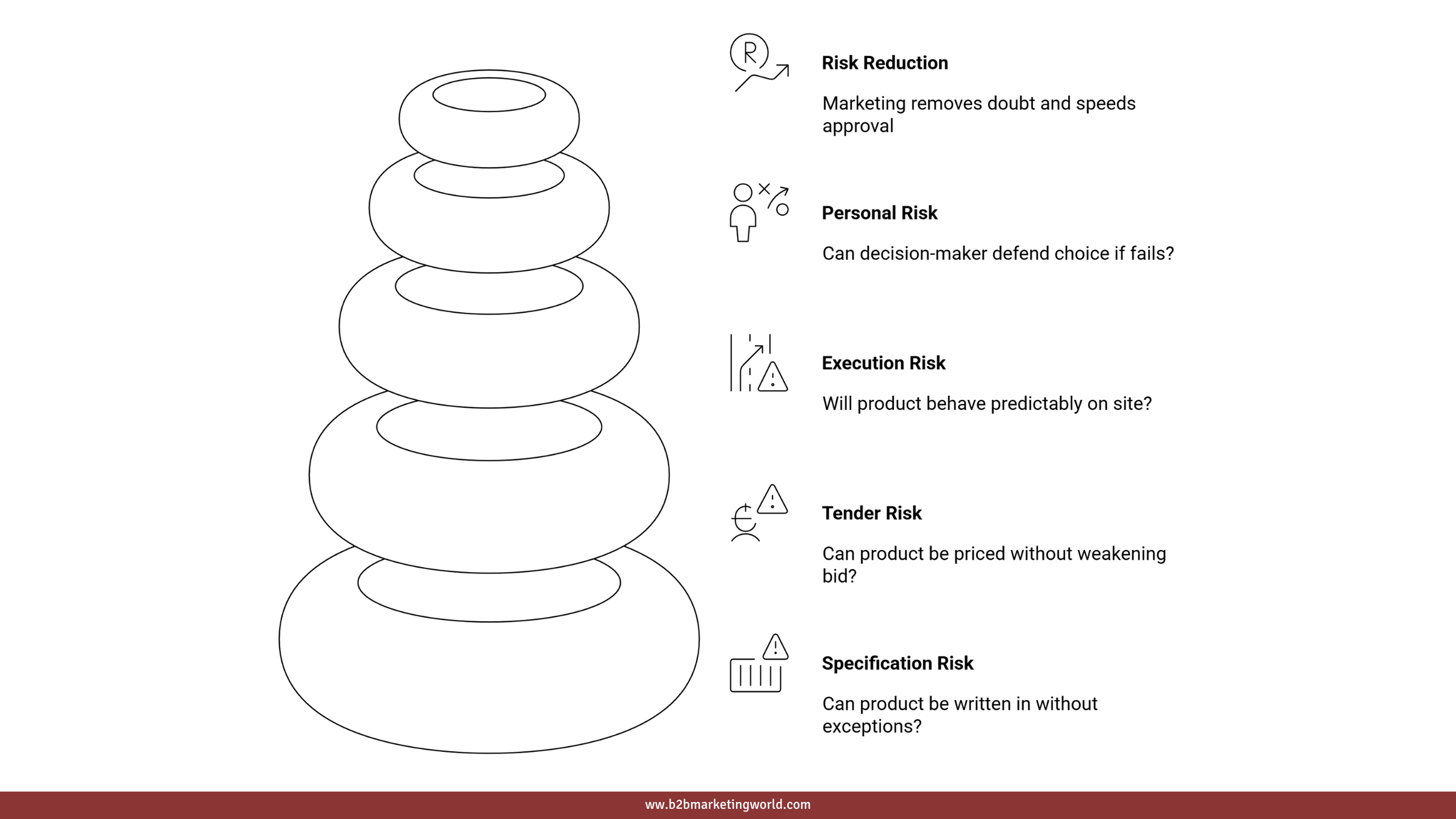
Cement Marketing Risk Reduction Pyramid © B2B Marketing World
| Risk | Explanation |
|---|---|
|
Specification risk
|
Can this be written in without exceptions or special justifications?
|
|
Tender risk
|
Can this be priced without caveats that weaken the bid?
|
|
Execution risk
|
Will this behave predictably on site, under local conditions?
|
|
Personal risk
|
Can the decision-maker defend this choice if something fails?
|
The B2B channels that actually influence specifications and project awards
Where emerging data-driven tools (EPDs, WLC inputs) shape decisions
|
Specifier / Engineer
|
Spec-ready docs, CPDs
|
Sets what is allowed into specs
|
|
Designer
|
Digital product data
|
Determines default selections
|
|
Contractor
|
Risk-framed case studies
|
Reduces execution uncertainty
|
|
Approver / Client
|
EPDs, WLC inputs
|
Enables sign-off and reporting
|
One concrete marketing idea that breaks the “commodity material” trap
Getting out of the commodity trap isn’t about more messaging. It takes one clear idea that matches how projects are approved and carried out. When cement and concrete are shown as controlled, low-risk systems instead of just interchangeable materials, marketing shifts from arguing for preference to helping decisions get made.
What to focus on here:
Summary TL;DR
- Cement and concrete are treated as commodities until risk makes accountability visible.
- Buyers screen marketing for downside; messages that add approval work get filtered out.
- Influence happens early, at spec and design stages, not during late-stage persuasion.
- Proof that is comparable and attachable beats claims that need explanation.
- A bundled, proof-led approach can reposition materials as low-risk project components.

Stephan Wenger
B2B Marketing Expert, Editor and Marketing Management Consultant
Stephan Wenger is a seasoned B2B Marketing Expert with more than 15 years of experience in leading global companies. His extensive expertise lies in the realms of B2B online marketing, content marketing, strategic marketing, and driving synergy between sales and marketing, including effective lead management.
You May Like the Following Articles

Semiconductor Marketing
Why semiconductor companies struggle to market, how most semiconductor marketers are fighting with one-person teams. This article shows you how: the five structural barriers to fix first, the channels that influence decisions, a framework for marketing around the design-win model, and a ready-to-adapt campaign blueprint.
Steel Supplier Marketing
This article reframes steel marketing as a decision-support system. See how early signals shape shortlists, how different buying roles rely on marketing to reduce risk, where common approaches fail, and what changes when marketing is built to support approvals instead of attention.
B2B Agricultural Machinery Marketing
Selling tractors, harvesters, or plows isn’t a quick process. Buyers take time, involve multiple decision-makers, and require a solid financial commitment. This is a full guide on B2B agricultural machinery marketing, including real-world examples from John Deere and Kubota.
B2B Construction Machinery Marketing
This is your guide to create a B2B marketing construction machinery roadmap + 3 Examples. Marketing in the construction machinery industry is complex but essential. Unlike consumer goods, purchasing decisions for heavy equipment like excavators, bulldozers, and loaders involve multiple stakeholders, long sales cycles and significant investments. This article provides a structured approach to B2B marketing for the construction machinery industry.
B2B Fintech Marketing
B2B fintech marketing promotes financial technology products to other businesses. It’s different from consumer marketing because the target group is companies like banks, insurance firms, and financial institutions. In this article, we explore the foundations of B2B fintech marketing. We look at key strategies, challenges, and how to measure success. We also discuss future trends that will shape this industry.
B2B Manufacturing Marketing
B2B manufacturing marketing involves promoting products and services from one business to another within the manufacturing sector. Key Points are: Complex Buying Process, Emphasis on Relationships, Technical Focus. This blog post will explore the unique aspects of B2B manufacturing marketing, its challenges, and effective strategies for overcoming them.
Build a B2B Marketing Funnel
Build a B2B marketing funnel requires 5 steps: creating a customer journey, mapping marketing channels, building a multi-touch attribution model, establishing and measuring KPIs, and constantly adapting the funnel. Read how to do this and learn that marketing and sales alignment are essential.