
Steel Supplier Marketing
How to Win When Buyers Are Managing Risk, Not Shopping Brands
No time? Read Summary
Table of Contents
Subscribe to our Newsletter and Learn B2B Marketing.
In the industrial steel sector, marketing decides which suppliers get approved before price comes into play.
This article reframes steel marketing as a decision-support system. It shows:
- how early signals shape shortlists,
- how different buying roles rely on marketing to reduce risk,
- where common approaches fail, and
- what changes when marketing is built to support approvals instead of attention.
How marketing influences steel buying decisions long before price is final
Steel buying decisions are made long before procurement talks about price. Early on, buyers focus on execution risk, not just getting a good deal. B2B marketing helps suppliers either lower that risk or make it worse, depending on how clearly they show availability, documentation, and delivery details to everyone involved.
What to focus on here:
Why early marketing signals frame the buying context
Before an RFQ exists, internal stakeholders are already asking whether a supplier is safe to involve. Marketing materials establish baseline expectations about reliability, compliance, and operational readiness. Those expectations determine who is shortlisted and who never enters the conversation.
How different roles use marketing to reduce internal risk
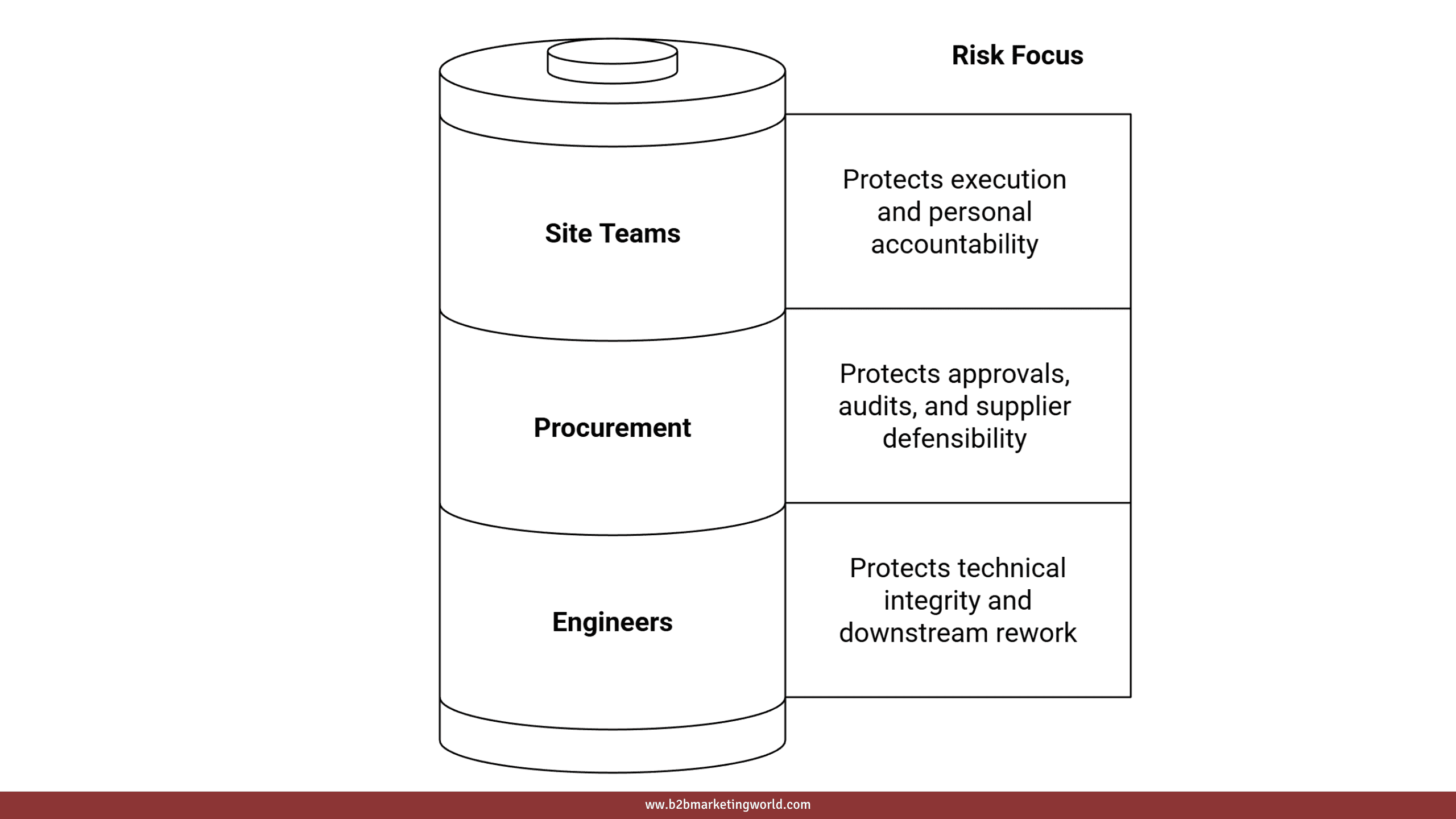
Steel buyer roles to be used for industrial steel marketing © B2B Marketing World
… protecting technical integrity and downstream rework.
Engineers use marketing to judge whether specifications will hold under real conditions.
- Availability clarity signals whether specified grades are realistic or likely to be substituted later
- Documentation access (datasheets, certificates, standards alignment) supports internal technical sign-off
- Delivery assumptions indicate whether design choices will survive schedule pressure
- Availability visibility supports planning and reduces last-minute sourcing risk
- Documentation completeness lowers compliance exposure and audit friction
- Delivery reliability signals help justify supplier selection beyond price
- Availability signals influence sequencing and installation planning
- Documentation readiness prevents stoppages on receipt
- Delivery clarity reduces the risk of missed milestones and on-site disruption
How marketing aligns the full buying group
Where steel marketing misses the point
What to focus on here:
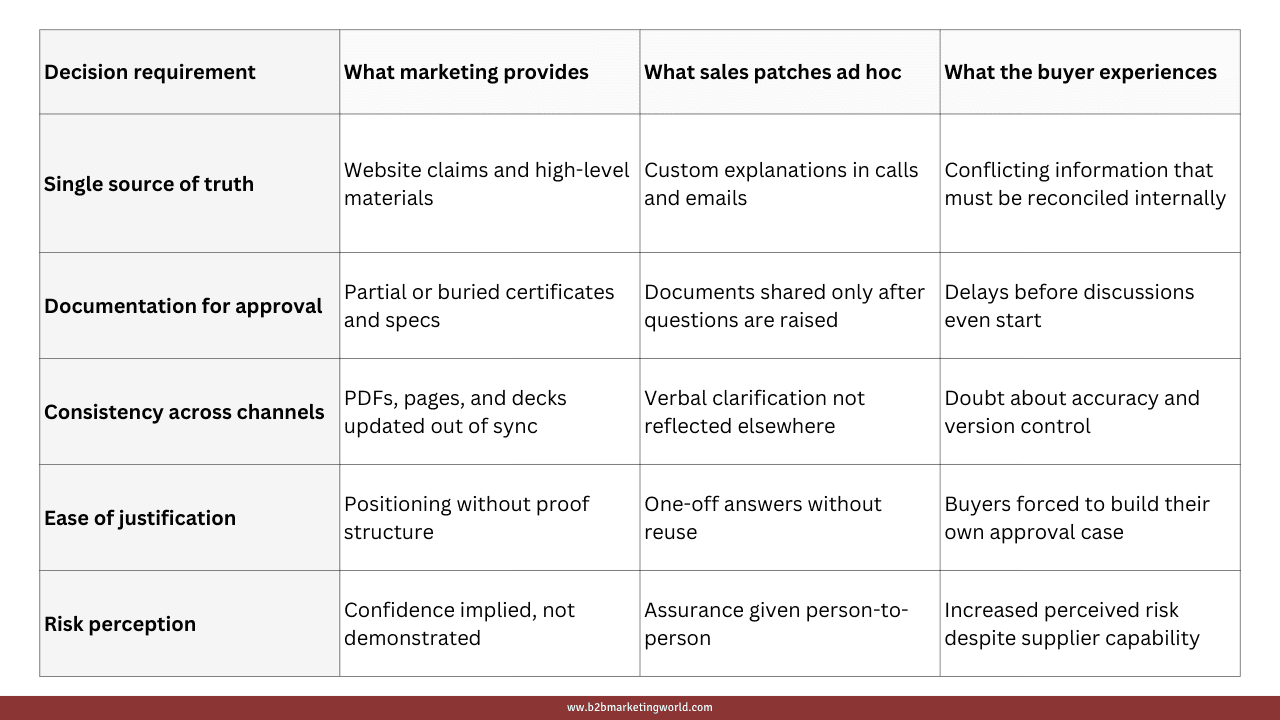
Steel Marketing Decision Requirements © B2B Marketing World
Even strong answers fail if they are not delivered in a consistent, accessible, and decision-ready form that buyers can trust without extra work.
Make steel marketing work
What to focus on here:
What usable marketing looks like by role
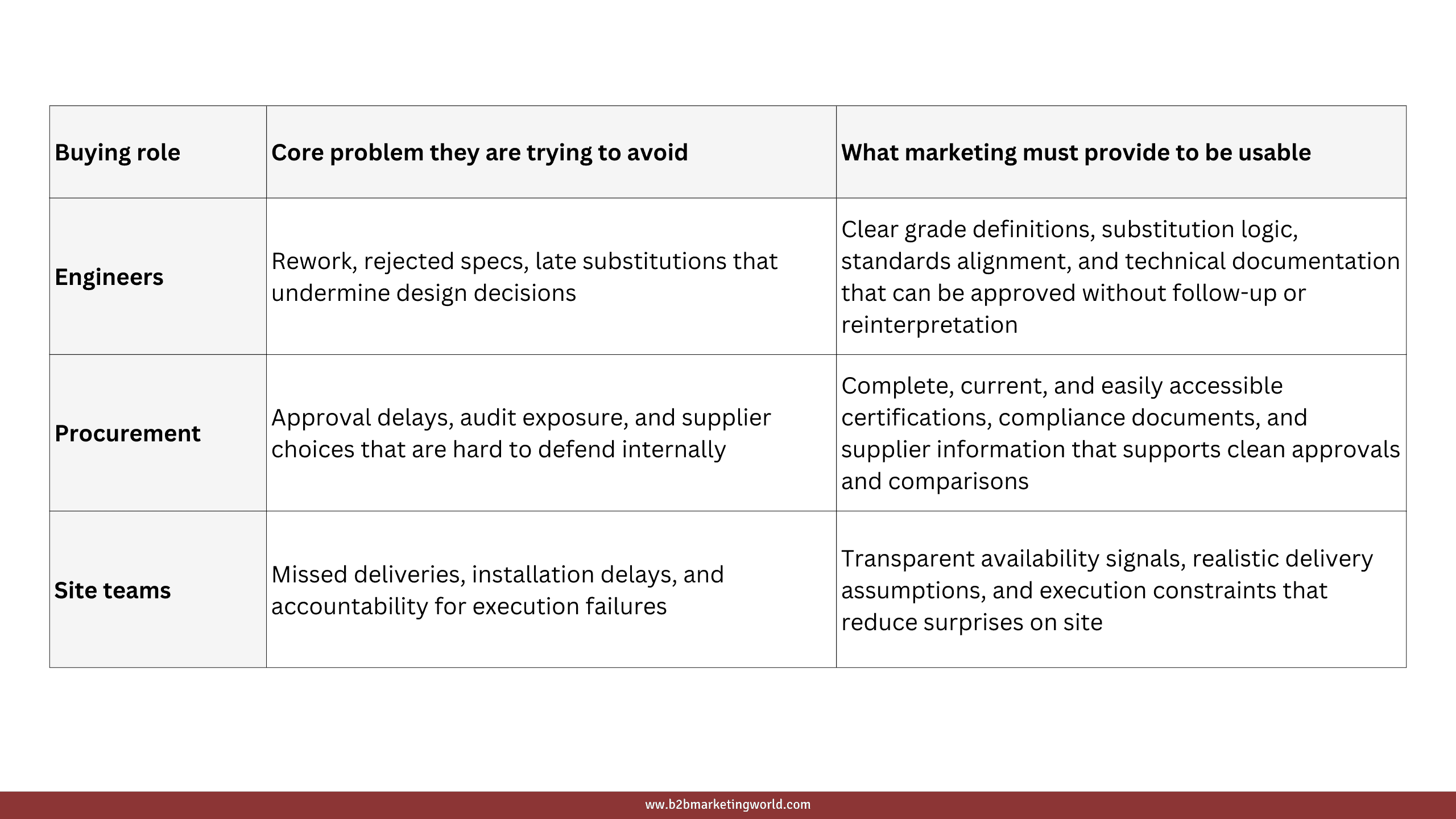
Table_Steel Marketing What usable marketing looks like by role © B2B Marketing World
How this approach enables scalable channels and execution
The B2B channels that actually work in steel. And why
What to focus on here:
SEO and technical content
Definition: Early-stage validation
- Clarifies grades, equivalents, and substitution limits
- Makes standards and certificates discoverable without contact
- State availability and lead-time constraints plainly
“If we can’t validate this without talking to sales, it’s too risky to shortlist.”
How proof packs and portals work together to carry approvals and execution
- Certifications and compliance statements
- Quality systems and audit-ready supplier information
- Delivery capabilities and constraints
- Sustainability inputs tied to reporting requirements
- Inventory and availability signals
- Certificate and document access
- Order and delivery status logic
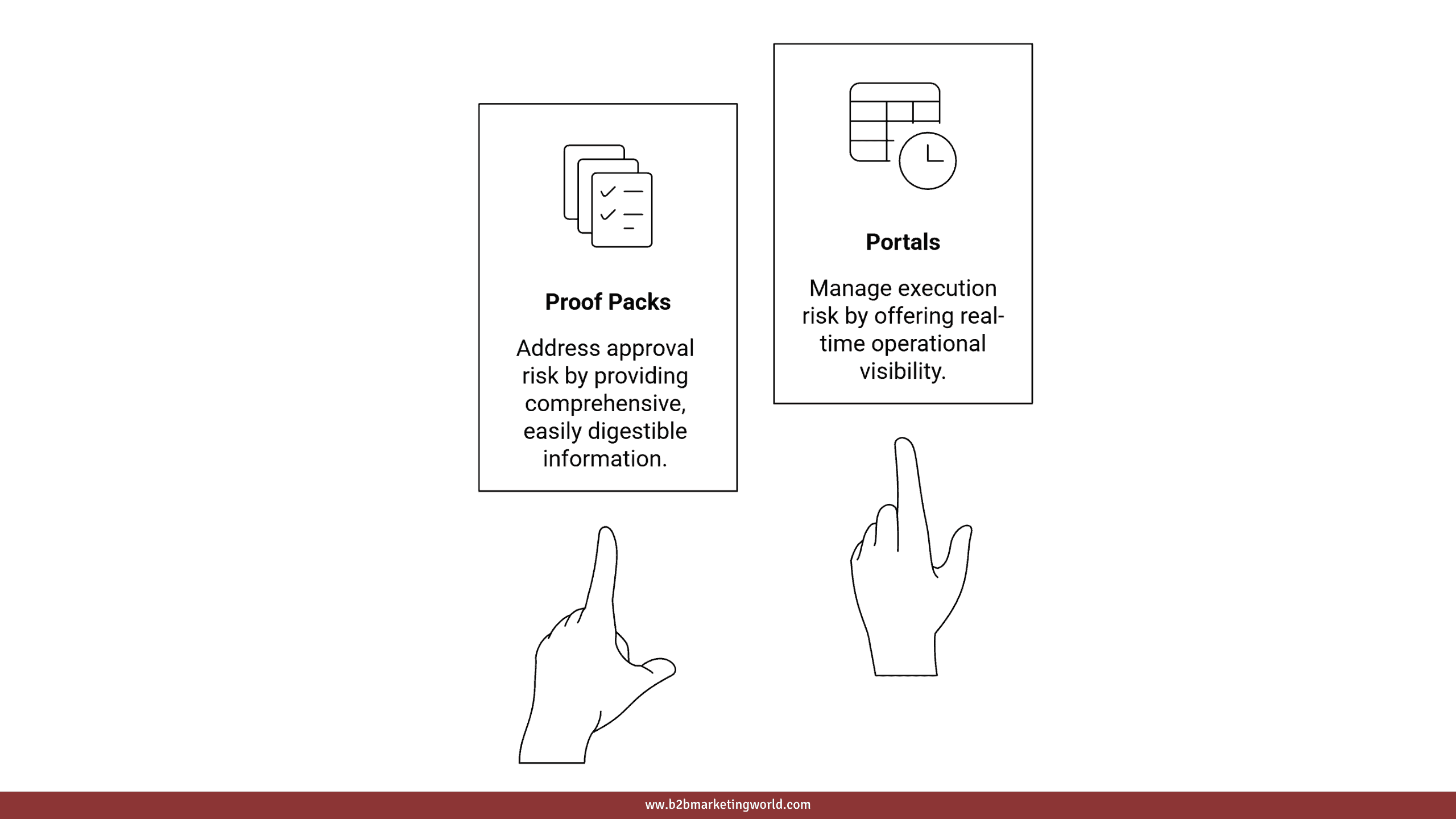
Ensure supplier reliability and manage risk © B2B Marketing World
Where email still works—and where it fails
- Points to a stable, trusted source of truth
- Is easily forwarded without explanation
- Reinforces what already exists elsewhere
Distributor vs direct models change channel priorities
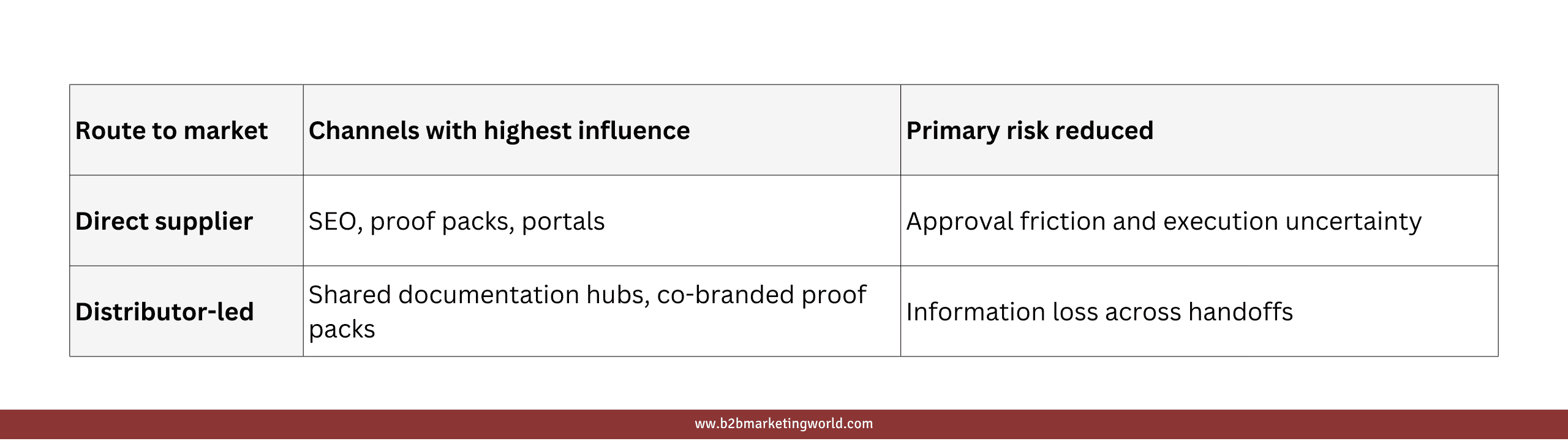
Table_Steel Marketing Channel Priorities © B2B Marketing World
One steel marketing move to get suppliers shortlisted
- A public-facing technical hub for grades, substitutions, standards, and early validation
- A downloadable, version-controlled procurement proof pack that survives internal approvals
- A customer portal exposing inventory signals, certificates, and delivery status
The critical move is that every RFQ response, email link, sales deck, and portal login points back to this same system.
The effect on shortlisting is subtle but important. When buyers are guided by convenience and trust to use the same interface for evaluation, the way they compare suppliers changes.
Suppliers are judged not by how well they explain themselves, but by how easy they are to approve without extra effort. Disorganized suppliers seem risky, while organized ones feel safe. Being easy to approve becomes a key factor long before price is discussed.
Summary TL;DR
Buyers are not comparing brands. They are filtering suppliers based on how easy they are to evaluate, approve, and work with across engineering, procurement, and site teams.
- Early marketing signals determine shortlists by reducing perceived execution, compliance, and delivery risk before procurement negotiates price
- Steel marketing fails when information is fragmented, undocumented, or unusable for approvals—even if the message itself is correct
- Marketing starts working when it is built as a decision infrastructure that supports real approval flows, not attention or persuasion
- Channels like SEO, proof packs, portals, and email succeed only when they function as coordinated risk-reduction tools
- Turning marketing into a single, mandatory decision interface quietly reshapes shortlists in favor of approvable, reliable suppliers

Stephan Wenger
B2B Marketing Expert, Editor and Marketing Management Consultant
Stephan Wenger is a seasoned B2B Marketing Expert with more than 15 years of experience in leading global companies. His extensive expertise lies in the realms of B2B online marketing, content marketing, strategic marketing, and driving synergy between sales and marketing, including effective lead management.
You May Like the Following Articles

Semiconductor Marketing
Why semiconductor companies struggle to market, how most semiconductor marketers are fighting with one-person teams. This article shows you how: the five structural barriers to fix first, the channels that influence decisions, a framework for marketing around the design-win model, and a ready-to-adapt campaign blueprint.
B2B Agricultural Machinery Marketing
Selling tractors, harvesters, or plows isn’t a quick process. Buyers take time, involve multiple decision-makers, and require a solid financial commitment. This is a full guide on B2B agricultural machinery marketing, including real-world examples from John Deere and Kubota.
B2B Construction Machinery Marketing
This is your guide to create a B2B marketing construction machinery roadmap + 3 Examples. Marketing in the construction machinery industry is complex but essential. Unlike consumer goods, purchasing decisions for heavy equipment like excavators, bulldozers, and loaders involve multiple stakeholders, long sales cycles and significant investments. This article provides a structured approach to B2B marketing for the construction machinery industry.
B2B Fintech Marketing
B2B fintech marketing promotes financial technology products to other businesses. It’s different from consumer marketing because the target group is companies like banks, insurance firms, and financial institutions. In this article, we explore the foundations of B2B fintech marketing. We look at key strategies, challenges, and how to measure success. We also discuss future trends that will shape this industry.
B2B Manufacturing Marketing
B2B manufacturing marketing involves promoting products and services from one business to another within the manufacturing sector. Key Points are: Complex Buying Process, Emphasis on Relationships, Technical Focus. This blog post will explore the unique aspects of B2B manufacturing marketing, its challenges, and effective strategies for overcoming them.
Build a B2B Marketing Funnel
Build a B2B marketing funnel requires 5 steps: creating a customer journey, mapping marketing channels, building a multi-touch attribution model, establishing and measuring KPIs, and constantly adapting the funnel. Read how to do this and learn that marketing and sales alignment are essential.