
B2B Marketing for Mining Equipment
How Buyers Decide, De-Risk, and Justify High-Stakes Investments
No time? Read Summary
When mining companies buy equipment, they focus more on risk, accountability, and internal approval processes than on innovation. Factors like uptime, safety, and cost-per-ton reliability matter more than unique features. Procurement rules and company standards also decide what can even be considered.
This article looks at how to B2B marketing mining equipment:
- how mining buyers really make choices,
- what concerns them most,
- which factors help win internal support,
- and why much B2B mining marketing misses the mark.
In mining companies, authority is spread out across site operations, corporate leaders, technical teams, and procurement, making the process cautious by nature. Decisions only move forward if they can stand up to review from HSE, engineering, finance, and operations.
Because of this, marketing that focuses on features, innovation, or general industrial value often falls flat. What works better is marketing that lowers perceived operational risk, offers solid proof from similar situations, and helps buyers justify their choices over time.
B2B Marketing forMining Equipment © B2B Marketing World
How Mining Equipment Buyers Really Make Decisions
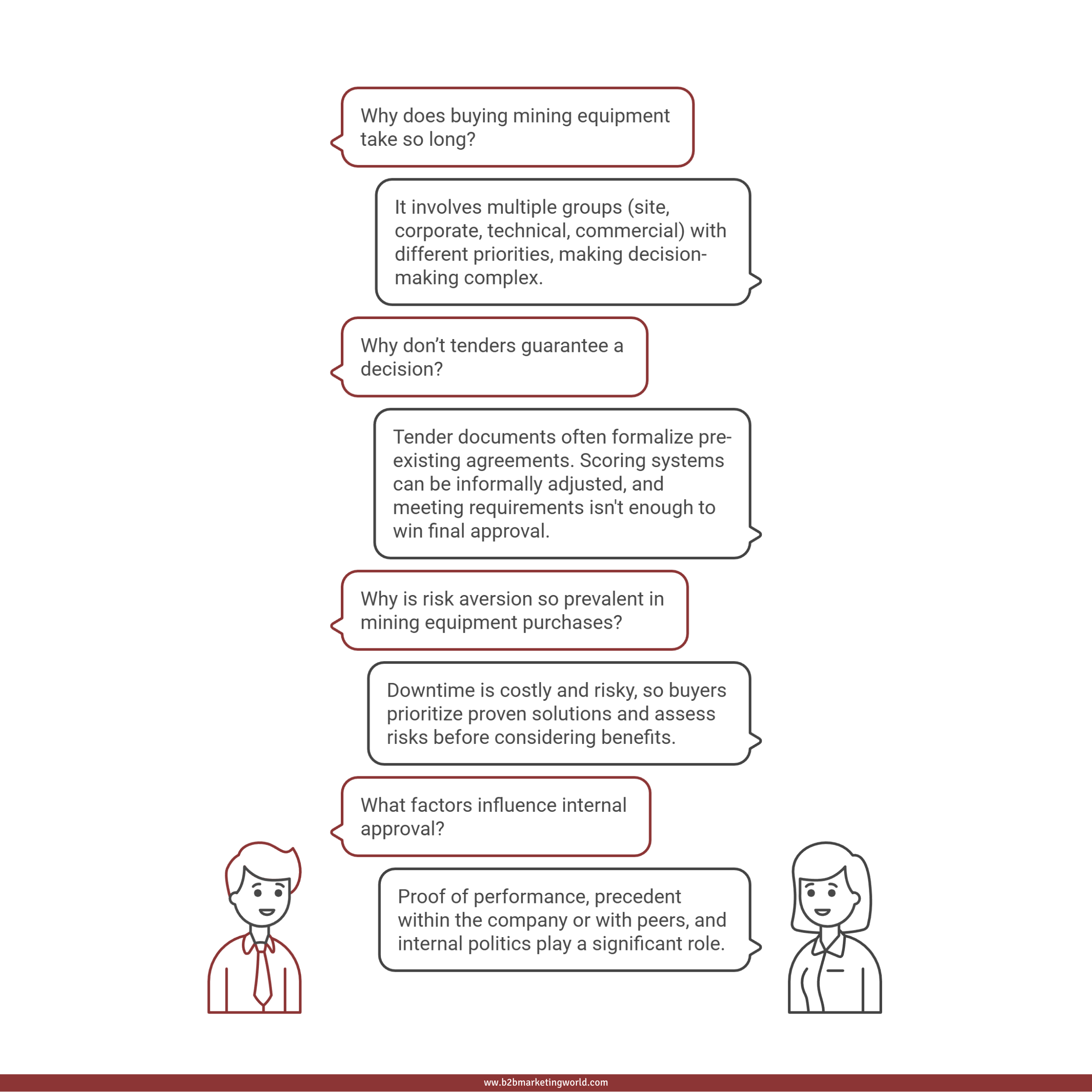
Mining equipment purchases almost never come from one decision-maker or a single moment. They result from several groups, like site, corporate, technical, and commercial, each doing their own evaluations. Knowing how these groups work together helps explain why buying takes a long time, moves slowly, and doesn’t always follow a straight path.
What to focus on here:
What Mining Buyers Fear Most (and How That Shapes B2B Marketing)
Mining buyers focus more on avoiding risks than chasing new opportunities. They care most about keeping operations running, staying safe, and being personally accountable. These worries shape how they judge, justify, and accept or reject new solutions.
What to focus on here:
B2B Marketing for Excavators, Drills, Haul trucks, Bulldozers, and Crushers © B2B Marketing World
Decision Drivers That Actually Win Internal Approval
To get internal approval in mining, decisions must be backed by logic that stands up to questions from operations, technical, and corporate teams. The best arguments are based on measurable results, risk reduction, and predictable costs—not just big promises. This matches how responsibility is shared in mining companies.
Here are the 5 main drivers:
Uptime and availability sit at the top of most approval frameworks because of their direct link to production output. Lost hours translate immediately into lost tonnes, making reliability a more powerful driver than nominal performance improvements. Buyers therefore focus on whether equipment can sustain consistent operation under real site conditions.
Productivity is measured by real results, like tonnes moved or processed per hour, not just what’s possible in theory. Consistent performance over time is more important than peak numbers that only happen in perfect conditions. Local factors like geology, climate, and how the site runs all affect whether productivity claims are trusted.
Initial purchase price is rarely decisive on its own. Buyers evaluate equipment through a total cost of ownership lens that spans its full operating life. Maintenance frequency, spare parts consumption, energy use, and rebuild intervals all shape how costs are perceived.
Losses from downtime are usually included in total cost of ownership, even if not shown directly. Finance teams care most about predictable costs, while site teams focus on how costs show up in daily operations. So, TCO stories change depending on the audience, but they’re always key to getting approval.
Reducing personnel exposure to hazardous environments is a powerful justification for change. Safety improvements are assessed in terms of risk reduction rather than the promise of eliminating risk entirely. Decision-makers look for clear links between equipment choices and lowered probability or severity of incidents.
HSE teams check if new solutions bring new hazards or shift risks in unexpected ways. Underground, where risks are higher, safety benefits matter even more. Often, safety can outweigh productivity or cost savings.
Sustainability matters when it fits with operational limits or regulatory demands. Decarbonization claims need to match the site’s infrastructure, power supply, and real-world conditions to be credible. Otherwise, they’re seen as just talk.
Corporate ESG goals can spark interest from the top, but approval depends on whether changes work at the site level. Sustainability is usually a secondary reason that supports the main business case. Buyers know the difference between long-term image value and short-term operational impact.
Approval is driven by defensible logic tied to uptime, predictable costs, and risk reduction. Productivity must be proven in site-relevant terms, while TCO and safety shape how decisions are justified internally. Sustainability matters most when it reinforces, rather than replaces, these core drivers.
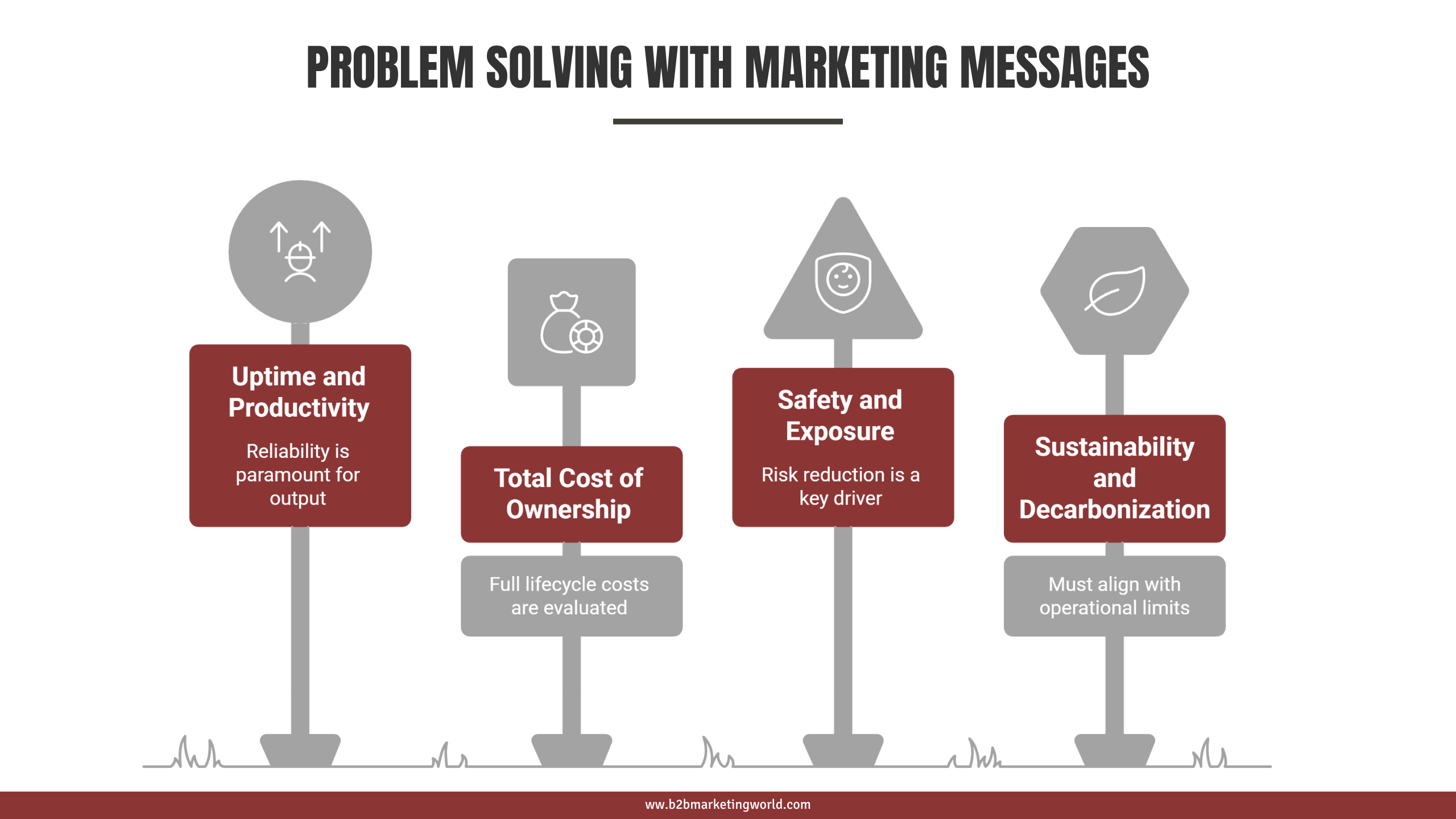
Problem Solving with B2B Marketing Messages © B2B Marketing World
Why Most Mining Equipment Marketing Misses the Mark
Many B2B marketing for mining equipment efforts fall short not because the products aren’t valuable, but because the messaging doesn’t match how buyers think about risk and decisions. Buyers judge proposals based on downtime, safety, and accountability. If marketing ignores these, even good solutions struggle to get noticed.
What you get here:
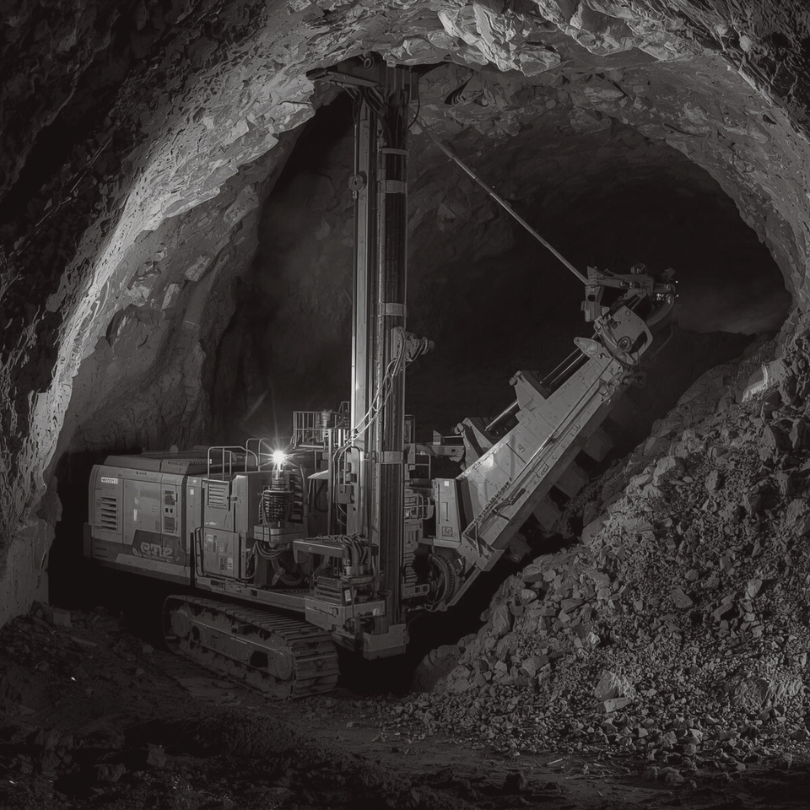
B2B Mining equipment marketing falls short when it focuses on features, innovation, or generic stories instead of addressing risk. Buyers pay attention to messaging that recognizes possible failures, governance rules, and mining’s unique challenges. To be credible and win approval, marketing must match how mining companies really judge risk.
B2B Marketing for Excavators, Drills © B2B Marketing World
Building B2B marketing for mining equipment That De-Risks the Decision
Effective mining equipment marketing reduces uncertainty rather than amplifying enthusiasm. Buyers use marketing materials to assess whether a decision can be defended under scrutiny from multiple functions. The goal is confidence, not persuasion.
4 B2B Marketing Strategies:
1. B2B Marketing as risk mitigation, not persuasion
Marketing outputs are judged by how well they reduce perceived operational and safety risk. Buyers look for validation of their assumptions, not arguments that push them toward change. Messaging that acknowledges constraints and potential downsides is more credible than one-sided optimism.
Framing marketing around risk reduction matches how decisions are justified inside companies. By talking about what could go wrong and how to handle it, B2B marketing helps build confidence with site, technical, and corporate teams. This makes marketing materials useful at every stage of approval.
2. Proof hierarchy: what counts as credible evidence
Not all proof is equally convincing. Evidence from similar mines, conditions, and use cases is much more persuasive than general success stories. Buyers value operational data that shows reliability over time.
Peer references reduce both personal and organizational risk, especially when they come from within the same company or a close peer group. Independent or internally generated proof is valued more than supplier-originated claims. In the absence of credible proof, skepticism becomes the default position.
3. Aligning messaging to lifecycle and service reality
Buyers evaluate equipment across its full operational lifecycle, not just the point of purchase. Serviceability, maintenance effort, spare parts availability, and rebuild pathways all influence approval decisions. Lifecycle framing helps buyers understand long-term risk exposure.
How well service is supported and how quickly issues are handled matter as much as equipment design for reliability. Messaging that talks about what happens after purchase feels more realistic and builds trust. Ignoring these points leaves gaps that reviewers will notice.
4. Supporting internal justification, not just interest
Marketing materials are often reused inside companies to justify decisions to finance, HSE, engineering, and leadership. Approval depends on whether the language holds up to questions from different teams. Materials that just spark interest don’t help move decisions forward.
Getting everyone on the same page inside the company matters more than outside excitement. Marketing helps when it gives buyers stories they can defend in meetings and reviews. Without solid reasons, interest fades and decisions don’t get approved.
Marketing that reduces risk matches how mining buyers get approval. Solid proof, realistic talk about the equipment’s life, and a focus on risk matter more than just trying to persuade. When B2B marketing helps buyers justify decisions inside the company, it becomes a useful tool in complex sales.
Strategic Takeaways for B2B Marketers in Mining
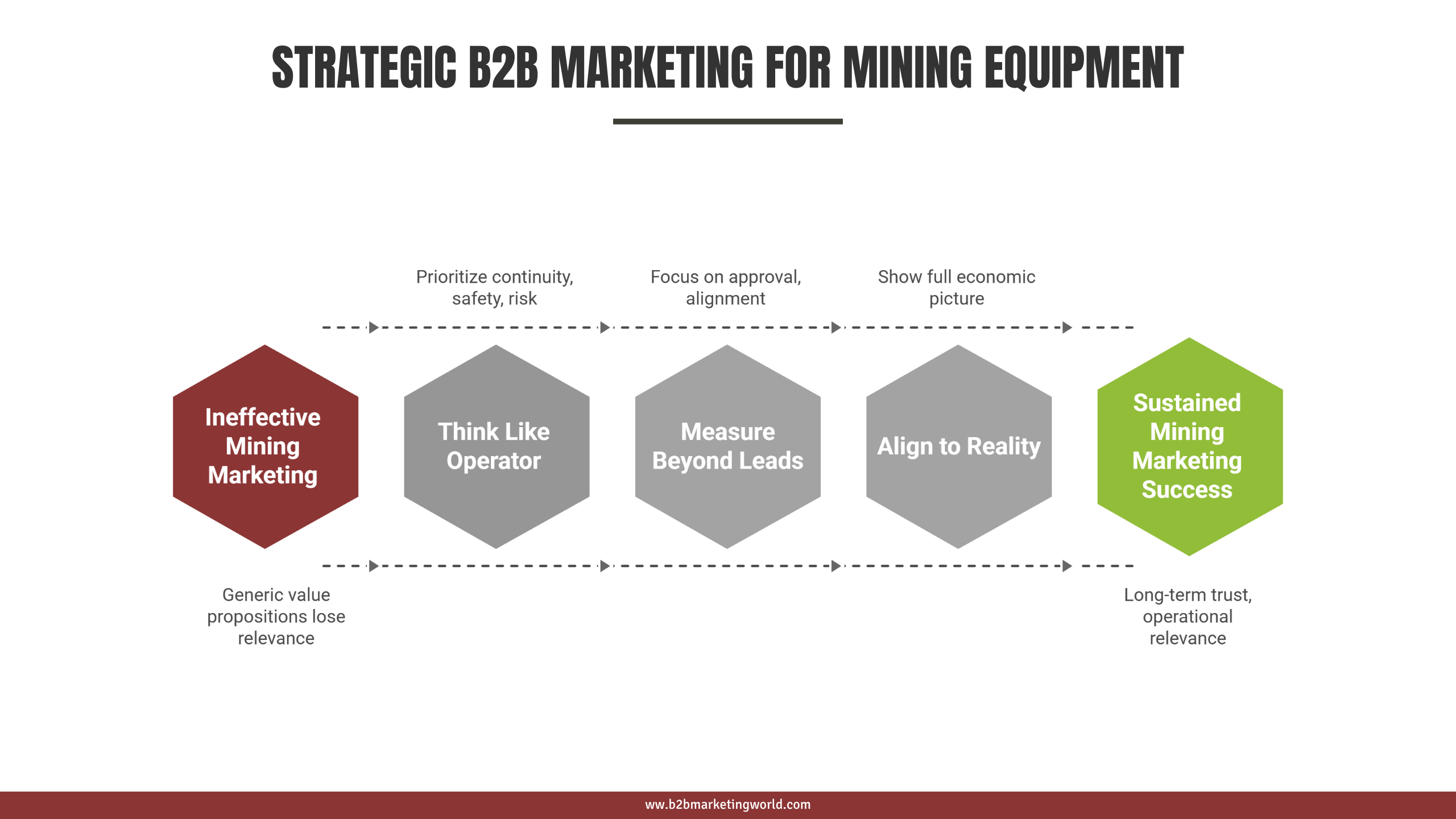
Good mining marketing begins by understanding how decisions are justified, not just how products are presented. Success comes from matching real operations, internal approval steps, and long decision cycles. These lessons turn buyer behavior into useful advice for B2B marketers and the foundation for a marketing strategy
Strategic B2B Marketing for Mining Equipment © B2B Marketing World
Summary
Mining equipment choices are driven by avoiding risk, not excitement about new ideas. Buyers focus on uptime, safety, and steady costs, with decisions shared across site, corporate, technical, and procurement teams. Tenders make official what’s already been shaped by proof, past experience, and company politics, and safety or reliability can outweigh price at the end. Marketing fails when it leads with features or innovation, but works when it lowers risk, offers solid proof from similar sites, covers the full lifecycle, and helps buyers justify their choices. In mining, marketing that reduces risk is much more effective than marketing that just tries to persuade.

Stephan Wenger
B2B Marketing Expert, Editor and Marketing Management Consultant
Stephan Wenger is a seasoned B2B Marketing Expert with more than 15 years of experience in leading global companies. His extensive expertise lies in the realms of B2B online marketing, content marketing, strategic marketing, and driving synergy between sales and marketing, including effective lead management.
You May Like the Following Articles

Steel Supplier Marketing
This article reframes steel marketing as a decision-support system. See how early signals shape shortlists, how different buying roles rely on marketing to reduce risk, where common approaches fail, and what changes when marketing is built to support approvals instead of attention.
B2B Agricultural Machinery Marketing
Selling tractors, harvesters, or plows isn’t a quick process. Buyers take time, involve multiple decision-makers, and require a solid financial commitment. This is a full guide on B2B agricultural machinery marketing, including real-world examples from John Deere and Kubota.
B2B Construction Machinery Marketing
This is your guide to create a B2B marketing construction machinery roadmap + 3 Examples. Marketing in the construction machinery industry is complex but essential. Unlike consumer goods, purchasing decisions for heavy equipment like excavators, bulldozers, and loaders involve multiple stakeholders, long sales cycles and significant investments. This article provides a structured approach to B2B marketing for the construction machinery industry.
B2B Fintech Marketing
B2B fintech marketing promotes financial technology products to other businesses. It’s different from consumer marketing because the target group is companies like banks, insurance firms, and financial institutions. In this article, we explore the foundations of B2B fintech marketing. We look at key strategies, challenges, and how to measure success. We also discuss future trends that will shape this industry.
B2B Manufacturing Marketing
B2B manufacturing marketing involves promoting products and services from one business to another within the manufacturing sector. Key Points are: Complex Buying Process, Emphasis on Relationships, Technical Focus. This blog post will explore the unique aspects of B2B manufacturing marketing, its challenges, and effective strategies for overcoming them.
Build a B2B Marketing Funnel
Build a B2B marketing funnel requires 5 steps: creating a customer journey, mapping marketing channels, building a multi-touch attribution model, establishing and measuring KPIs, and constantly adapting the funnel. Read how to do this and learn that marketing and sales alignment are essential.
First 90 days for a B2B CMO
In this guide, I’m going to share with you 11 steps to take in the first 90 days of your cadence if you join a B2B company with a high ACV product as a new CMO. As a new chief marketing officer in a B2B company, it's important to hit the ground running and establish a strategy for aligning marketing and sales efforts.