
Oil and Gas Drilling Marketing
How to Reach Buyers Who Trust Field Results More Than Sales Pitches
No time? Read Summary
Table of Contents
Subscribe to our Newsletter and Learn B2B Marketing.
You sell to drilling operations. Your buyers run rigs that cost $330,000 a day. They don’t browse your website for fun, and they definitely don’t switch suppliers because of a well-designed brochure.
Oil and gas drilling marketing is different from almost any other B2B segment. Sales cycles stretch over months. Purchasing decisions involve 5 or more stakeholders. And trust isn’t built through content: it’s built through field-proven results and the confidence that your product won’t cause a single hour of downtime on a live well.
“So why bother with marketing at all?”
Because your buyers have already changed. 89% of B2B buyers research online before making a purchase. The new generation of drilling managers expects quick information, self-service tools, and peer reviews. They’ve changed. Most oilfield services companies haven’t.
This guide covers the shift that’s already happening: not the death of relationship selling, but the rise of a hybrid model where marketing warms up buyers before the first handshake and keeps your company visible between contract cycles. You’ll learn which channels actually work, why most marketing gets ignored in this space.
Most Marketing Gets Ignored in Oil and Gas Drilling
What the Buying Process Actually Demands
Most B2B Marketing playbooks assume you’re talking to one buyer. Maybe two. You craft a message, target a role, and nurture that lead through a funnel until they convert.
In drilling operations, that approach falls apart on day one.
The buying process here is rigid, multi-layered, and built for risk avoidance, not speed. If your marketing doesn’t match that reality, it gets ignored. Not because it’s bad marketing. Because it’s marketing for the wrong structure.
Here’s why:
Three People Touch Every Purchase. And Marketing Usually Reaches One
Every drilling purchase passes through 3 distinct groups, each with different priorities:
- Role: Drilling engineers, reservoir engineers
- What they need from you: Technical proof: specs, performance data, formation-specific case studies
- Role: Procurement directors, supply chain managers
- What they need from you: Commercial proof: pricing, compliance, delivery reliability, contract terms
- Role: Wellsite supervisors, field operations
- What they need from you: Operational proof: ease of use, mobilization speed, field support
Most oilfield services marketing speaks to one of these groups.
Usually the specifier, because engineers are the easiest to target with technical content. But the procurement team controls the budget. And the field crew has veto power based on what actually works on-site.
If your content only addresses one group, 2 out of 3 decision participants never see a reason to support you. That’s not a messaging problem. That’s a structural blind spot.
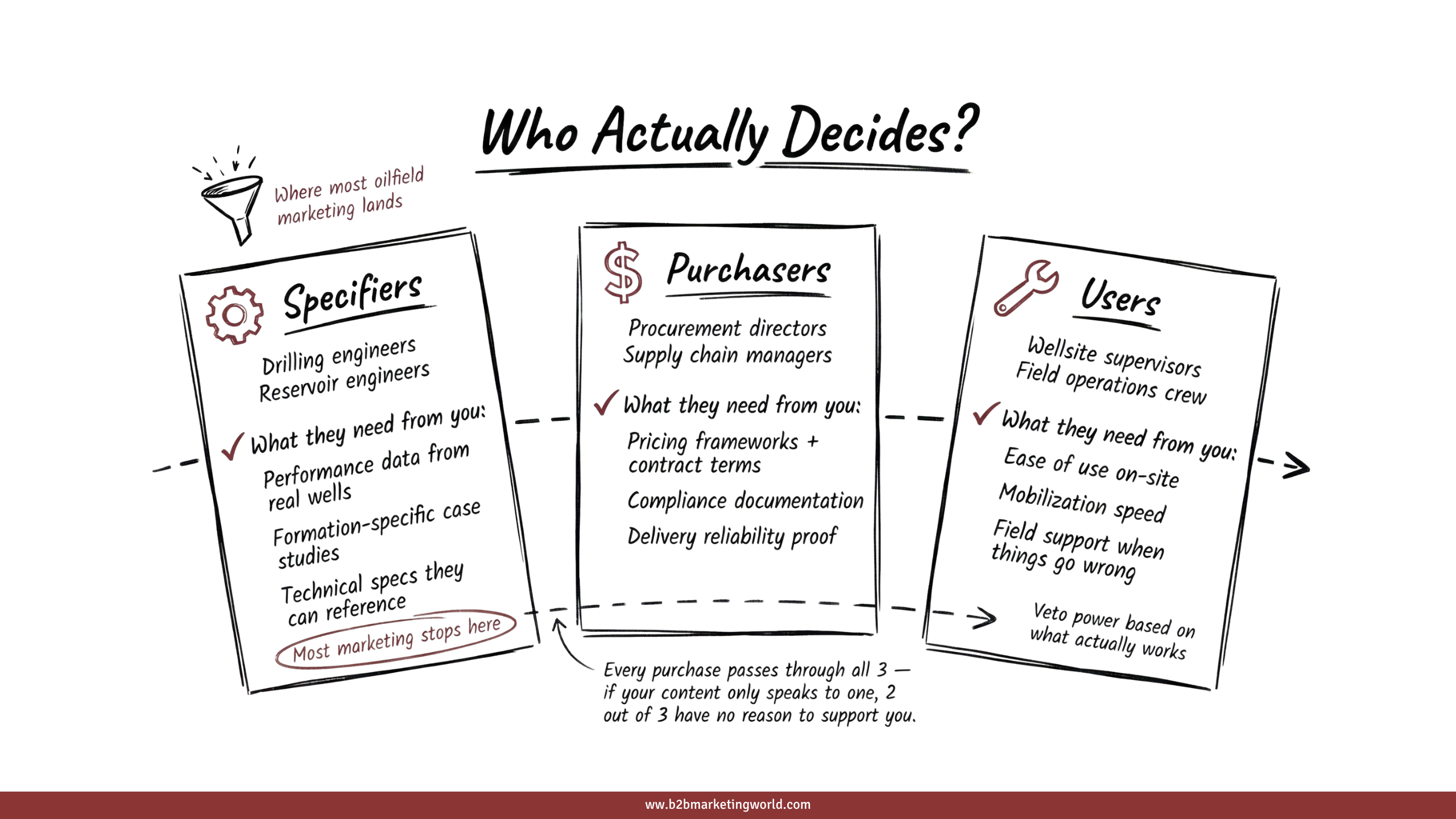
The 3 Buyer Groups in Oil and Gas Drilling Marketing © B2B Marketing World
When a Wrong Order Stops a $330,000-a-Day Rig, Nobody Trusts a Brochure
The procurement cycle in upstream drilling follows a clear sequence: need identification, specification, supplier qualification, tendering, evaluation, and contract award. Every step exists to reduce risk.
And the logic is simple: when a delayed delivery or a wrong component stops a rig that burns through $330,000 or more per day, nobody wants to be the person who chose the supplier based on a PDF download.
This is why 88% of B2B buyers in oil and gas prefer companies that demonstrate deep operational knowledge. They don’t just want to know what you sell. They want to know that you understand their well conditions, their formation challenges, and their operational constraints.
Generic marketing materials don’t survive this filter.
What does survive: field-proven results, documented performance under specific conditions, and references from operations teams who’ve actually used your product.
The Generational Split: Digital-Native Managers Inside Legacy Procurement Systems
Here’s where it gets interesting. A new generation of drilling managers, now in their 30s and 40s, is moving into decision-making roles. They research online. They expect self-service tools, peer reviews, and quick access to technical information.
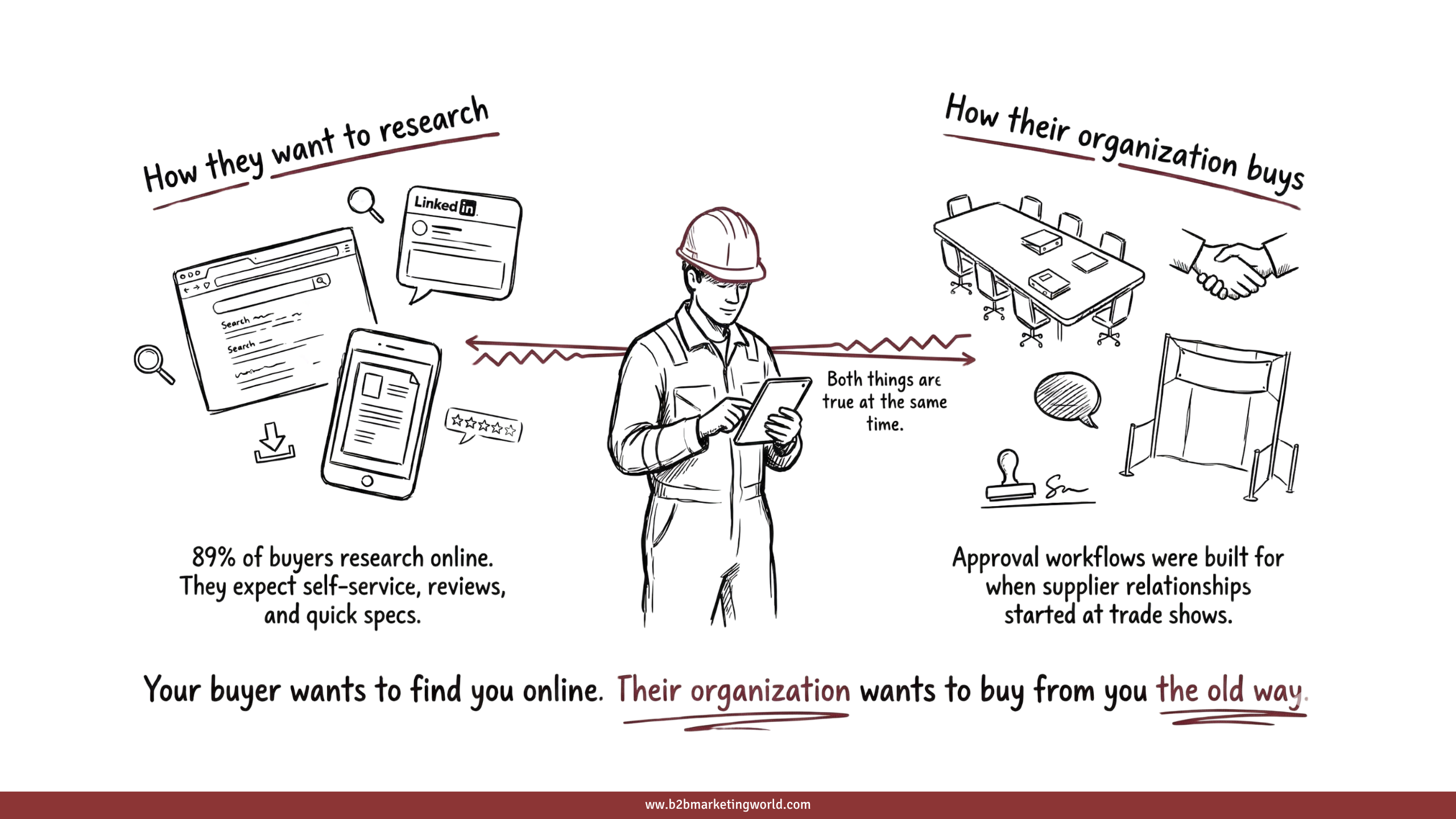
Old vs New Way of Marketing Oil and Gas Drilling © B2B Marketing World
But they operate inside organizations that haven’t updated their digital marketing strategy in 5 or more years. The procurement systems are legacy. The approval workflows are built for a world where every supplier relationship started with a handshake at a trade show.
This creates a real tension. Your buyer wants to find you online. Their organization wants to buy from you the old way. Both things are true at the same time.
For marketers, this means you can’t go all-in on digital and ignore the relationship side.
But you also can’t keep relying on trade shows and direct sales alone and hope the next generation will just adapt. The companies that win here are the ones that serve both: digital content that helps the new buyer research and validate you, combined with the personal engagement their organization still requires to sign a contract.
That’s the reality of marketing to drilling operations.
It’s not one buyer, one channel, or one message.
It’s a structured, multi-stakeholder process where trust is everything and every piece of content has to earn its place.
Which brings us to the core issue: if this is how buyers work, which marketing channels actually match this structure?
Trade Show Marketing Still Close Deals
But Only If You Treat Them as More Than a Booth
Trade shows absorb 30 to 40% of marketing budgets in oil and gas. That’s a massive investment. And for drilling operations specifically, it makes sense: buyers need to see equipment, test it, and talk to the engineers behind it before they’ll consider putting it on a rig.
Events like OTC, SPE ATCE, ADIPEC, and SUPER DUG draw decision-makers, drilling engineers, and project managers from over 100 countries. These aren’t optional networking events. For many oilfield services companies, the show floor is where shortlists are built and supplier relationships begin.
Fair enough. But most companies waste this investment.
They book a booth, fly in the team, hand out branded pens, and hope the right people walk by. That’s not a marketing strategy. That’s expensive brand decoration.
This is the right approach:
The Real ROI Happens Before and After the Show Floor
The companies that get real returns from trade shows treat the event as the middle of the campaign, not the whole thing. The work starts weeks before and continues months after.
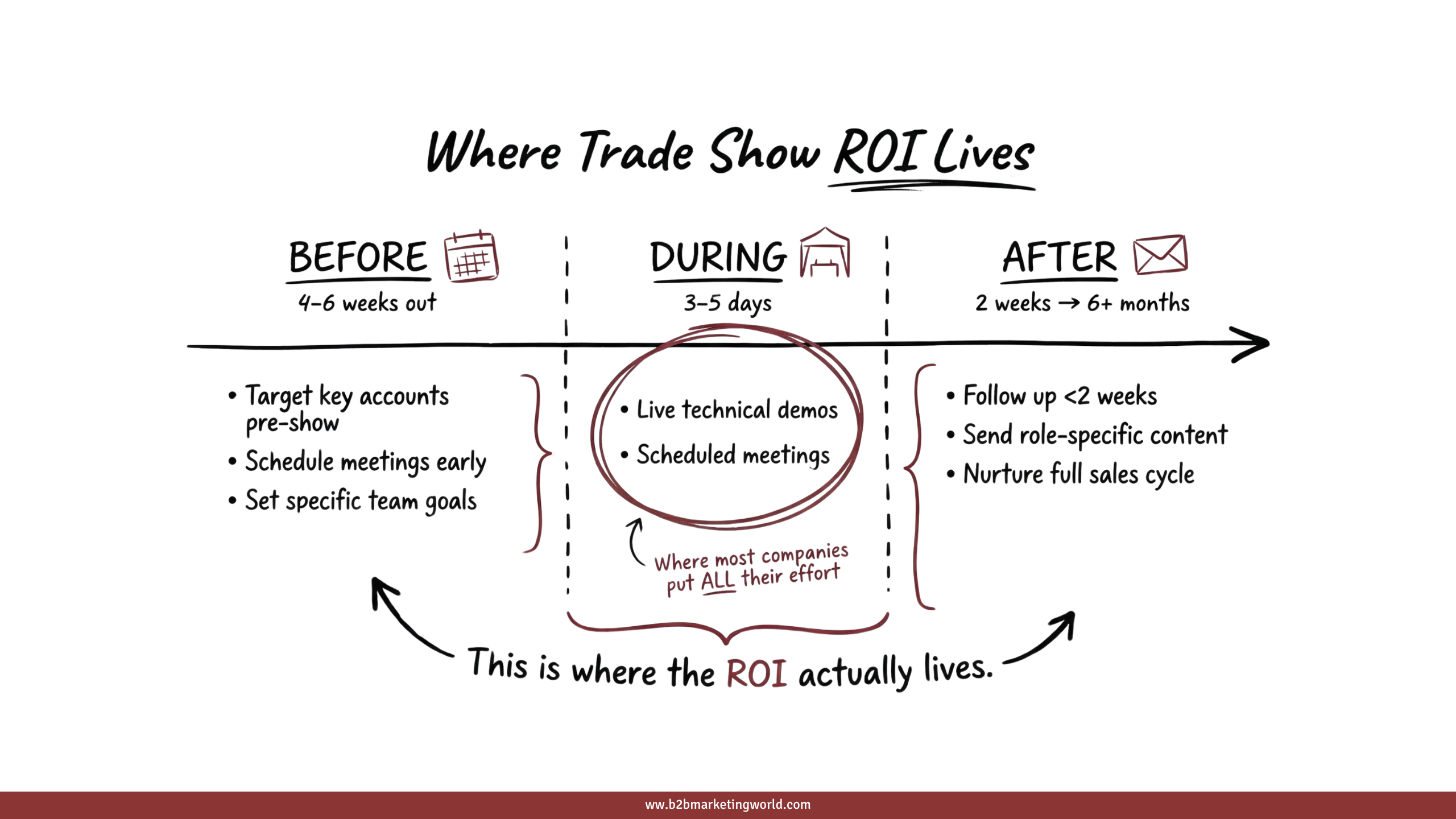
Trade Show Marketing ROI © B2B Marketing World
The logic is simple: the show floor opens the door. Everything before and after determines whether you walk through it.
Equipment Decisions Happen at Live Demos, Not in Conference Rooms Six Months Later
There’s one thing trade shows do that no digital channel can fully replace: live equipment demonstrations compress months of trust-building into minutes.
A drilling buyer evaluating a new bit design or a directional drilling tool doesn’t want to read about it. They want to hold it. Ask the engineer hard questions. See how it performs under pressure.
That’s where a product moves from “interesting” to “shortlisted.”
The buyer goes back to the office, procurement runs their cycle, evaluations happen. But the initial conviction? Formed in person, at the demo. Not 6 months later in a conference room looking at slides.
For marketers, the implication is clear: your booth isn’t a display. It’s a decision environment. The layout, the demos you prepare, the technical staff you bring: all of it should answer one question.
“Can I trust this to perform on my rig?”
Trade shows aren’t dying in drilling operations.
But the ROI doesn’t come from showing up. It comes from everything around the event: preparation, targeted outreach, live demos, and follow-up that turns a handshake into a real opportunity.
That’s the Trust Building Moment
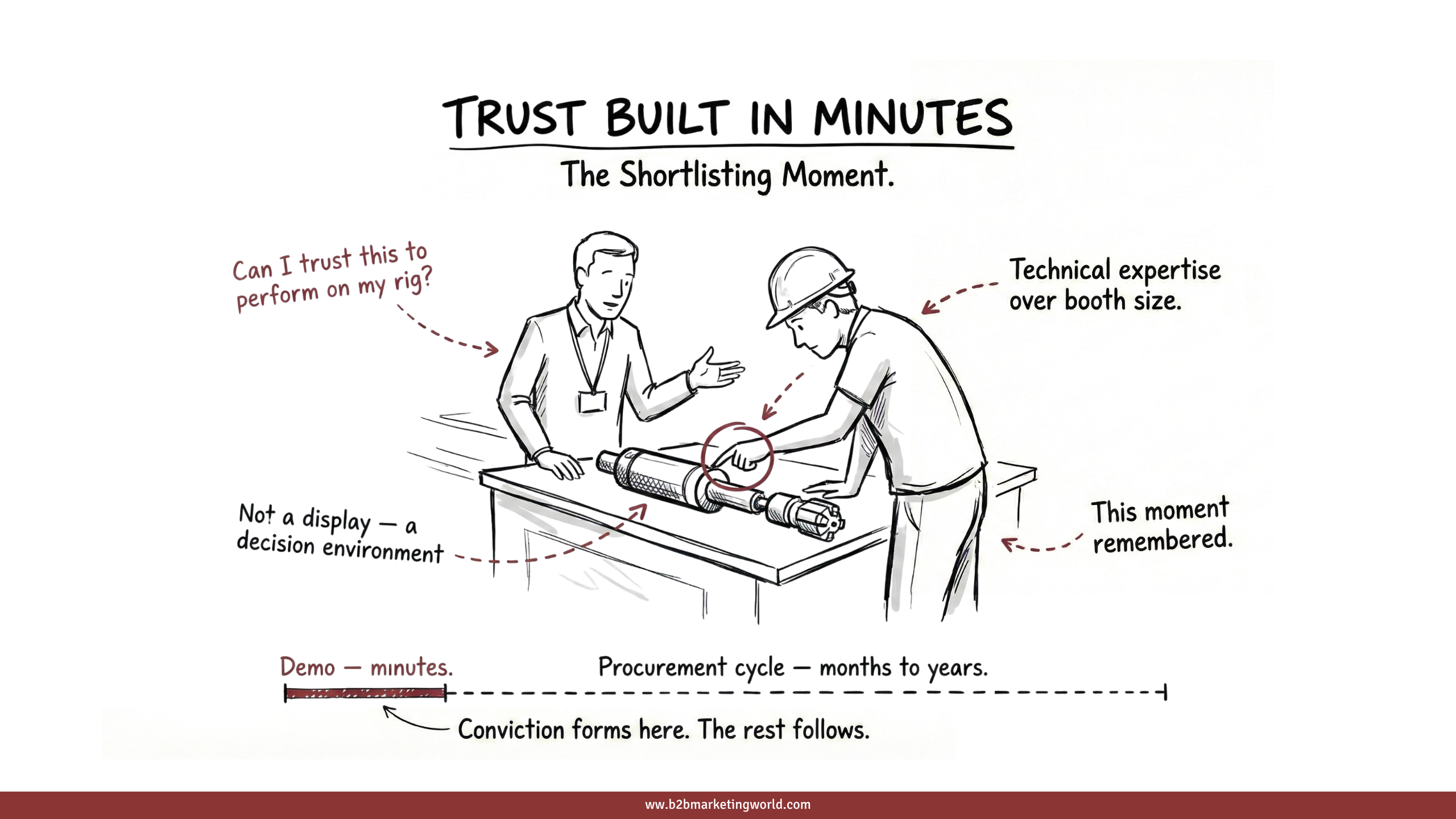
The Trust Building Moment © B2B Marketing World
And this is where it gets practical.
Trade shows build trust in person. But your buyers are also researching online, long before they walk the show floor. That’s where digital channels come in.
Digital Oil and Gas Drilling Marketing
The Digital Channels That Actually Work When Your Buyer Researches Online but Signs Contracts Offline
89% of B2B buyers research online before making a purchase. In drilling operations, that number doesn’t mean they’ll buy online. It means they’ll validate you online before they ever take your call.
- Your buyer is Googling your company name after meeting you at OTC.
- They’re checking your LinkedIn before responding to your sales rep’s email.
- They’re comparing your case studies to your competitor’s before the procurement team even sends out the tender.
The question isn’t whether digital matters. It’s which digital channels actually fit a market where contracts are still signed offline and trust is still built through relationships.
Not all of them do. Here are the ones that work:
That’s the digital picture. Not one channel, but a combination.
Technical content that proves your expertise, LinkedIn that gives your people a voice, SEO that captures intent, and email that maintains presence across long cycles.
None of these replace trade shows or relationship selling. They support them.
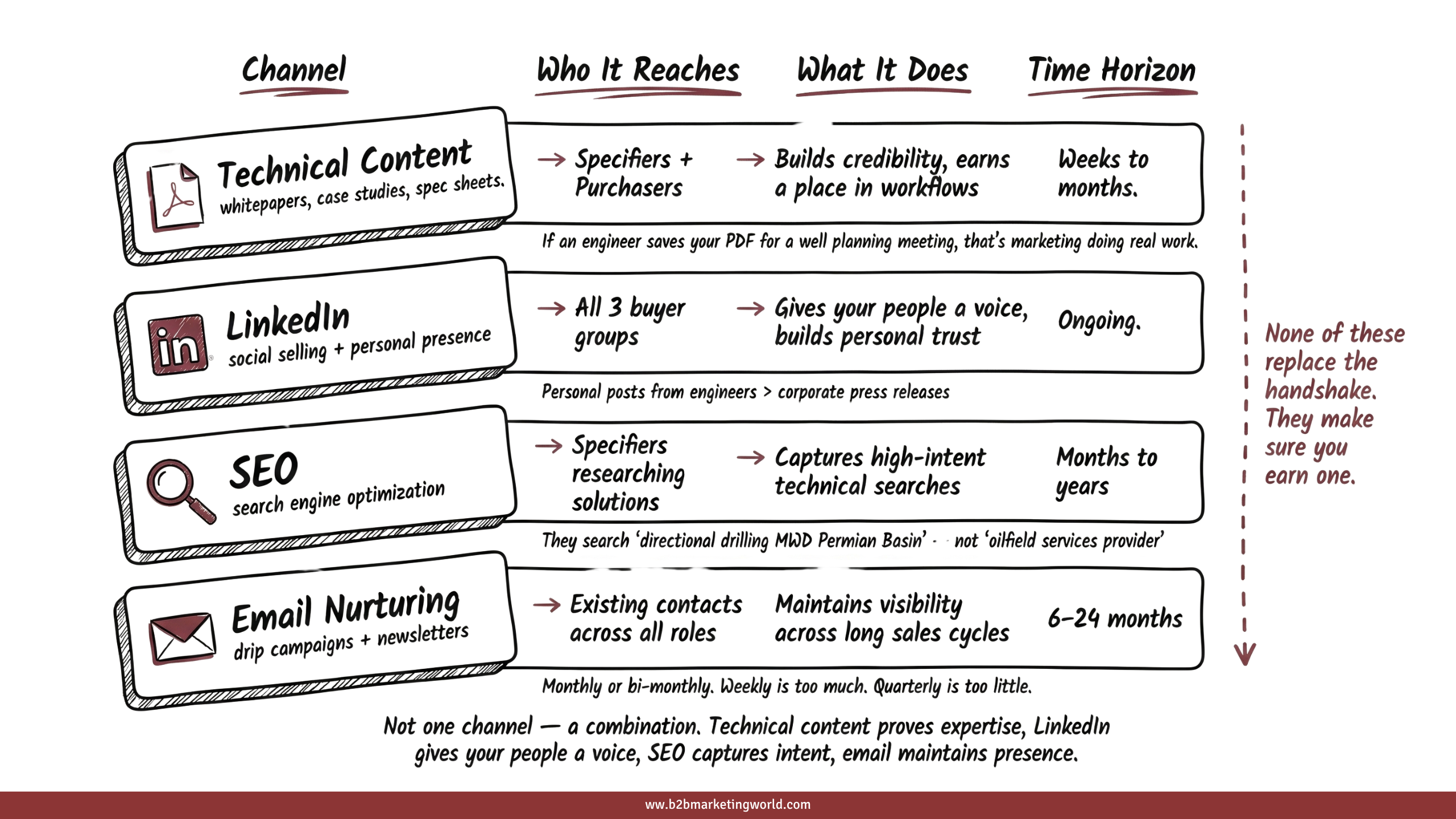
Digital Channels That Work in Oils and Gas Drilling Marketing © B2B Marketing World
But this only works if you’re willing to change how marketing and sales work together. That’s the shift we’ll cover next.
From Relationship Selling to Hybrid Model
Why the Shift Is Already Happening
There’s a common reaction when marketers in oilfield services hear about digital channels: “That’s nice, but our business runs on relationships.”
To some extent, they’re correct.
Drilling is a trust-heavy market. Contracts worth millions get signed because a VP of Drilling knows your team, has seen your equipment perform, and trusts you to deliver when it matters. No LinkedIn post replaces that.
But the way that trust gets built is changing. And pretending it isn’t is a risk.
Over 70% of oil and gas decision-makers now prefer digital self-service or remote contact for their initial research. They still want the relationship. They just don’t want it to be the only way they learn about you.
Think about what that means.
That’s shift number one: trust still matters, but it starts online now.
Shift number two is easier to miss.
Equipment rental models now account for 58% of North American oilfield service delivery. You’re no longer selling a product once. You’re providing an ongoing service. Your buyer evaluates you continuously, not just at the point of purchase. That means marketing isn’t about generating a one-time lead. It’s about proving ongoing value through consistent content and visible expertise.
So what does the right model look like?
Marketing generates qualified interest early. Sales focuses on technical consulting and closing complex deals.
Neither works well alone.
Companies that combine trade show presence, digital content, and field-proven proof points outperform those relying on any single channel.
Relationships still matter. But the companies waiting for a handshake to start the conversation are losing ground to the ones who showed up in the buyer’s research 6 months earlier.
What This Means for Your Marketing in Drilling Operations
Marketing in oil and gas drilling isn’t about replacing the handshake. It’s about making sure you earn the right to shake hands in the first place.
The buyers haven’t changed what they value.
They still want proven reliability, technical depth, and suppliers they can trust with a $330,000-a-day rig. What changed is where they start looking.
Summary [TL;DR]
- Your buyer isn’t one person. It’s 3 groups (specifiers, purchasers, users) with different needs. If your marketing only speaks to one, the other 2 have no reason to support you.
- Trade shows still work, but only if you treat them as the middle of a campaign, not the whole thing. The ROI lives in preparation and follow-up.
- Digital channels don’t replace relationships. They support them. Technical content, LinkedIn, SEO, and email nurturing keep you visible across sales cycles that run in years.
- The shift from pure relationship selling to a hybrid model isn’t coming. It’s already here. 70% of your buyers prefer to start their research digitally.
- The strongest marketing move you can make isn’t louder messaging. It’s removing friction from your buyer’s workflow.
Your competitors aren’t waiting for the next trade show to get in front of your buyers. They’re already in their search results, their LinkedIn feed, and their inbox.
The question isn’t whether marketing matters in drilling. It’s whether your buyers find you before they find someone else.

Stephan Wenger
B2B Marketing Expert, Editor and Marketing Management Consultant
Stephan Wenger is a seasoned B2B Marketing Expert with more than 15 years of experience in leading global companies. His extensive expertise lies in the realms of B2B online marketing, content marketing, strategic marketing, and driving synergy between sales and marketing, including effective lead management.
You May Like the Following Articles

Semiconductor Marketing
Why semiconductor companies struggle to market, how most semiconductor marketers are fighting with one-person teams. This article shows you how: the five structural barriers to fix first, the channels that influence decisions, a framework for marketing around the design-win model, and a ready-to-adapt campaign blueprint.
Steel Supplier Marketing
This article reframes steel marketing as a decision-support system. See how early signals shape shortlists, how different buying roles rely on marketing to reduce risk, where common approaches fail, and what changes when marketing is built to support approvals instead of attention.
B2B Agricultural Machinery Marketing
Selling tractors, harvesters, or plows isn’t a quick process. Buyers take time, involve multiple decision-makers, and require a solid financial commitment. This is a full guide on B2B agricultural machinery marketing, including real-world examples from John Deere and Kubota.
B2B Construction Machinery Marketing
This is your guide to create a B2B marketing construction machinery roadmap + 3 Examples. Marketing in the construction machinery industry is complex but essential. Unlike consumer goods, purchasing decisions for heavy equipment like excavators, bulldozers, and loaders involve multiple stakeholders, long sales cycles and significant investments. This article provides a structured approach to B2B marketing for the construction machinery industry.
B2B Fintech Marketing
B2B fintech marketing promotes financial technology products to other businesses. It’s different from consumer marketing because the target group is companies like banks, insurance firms, and financial institutions. In this article, we explore the foundations of B2B fintech marketing. We look at key strategies, challenges, and how to measure success. We also discuss future trends that will shape this industry.
B2B Manufacturing Marketing
B2B manufacturing marketing involves promoting products and services from one business to another within the manufacturing sector. Key Points are: Complex Buying Process, Emphasis on Relationships, Technical Focus. This blog post will explore the unique aspects of B2B manufacturing marketing, its challenges, and effective strategies for overcoming them.
Build a B2B Marketing Funnel
Build a B2B marketing funnel requires 5 steps: creating a customer journey, mapping marketing channels, building a multi-touch attribution model, establishing and measuring KPIs, and constantly adapting the funnel. Read how to do this and learn that marketing and sales alignment are essential.