
Semiconductor Marketing
Why Semiconductor Companies Struggle to Market a $975 Billion Industry
No time? Read Summary
Table of Contents
Subscribe to our Newsletter and Learn B2B Marketing.
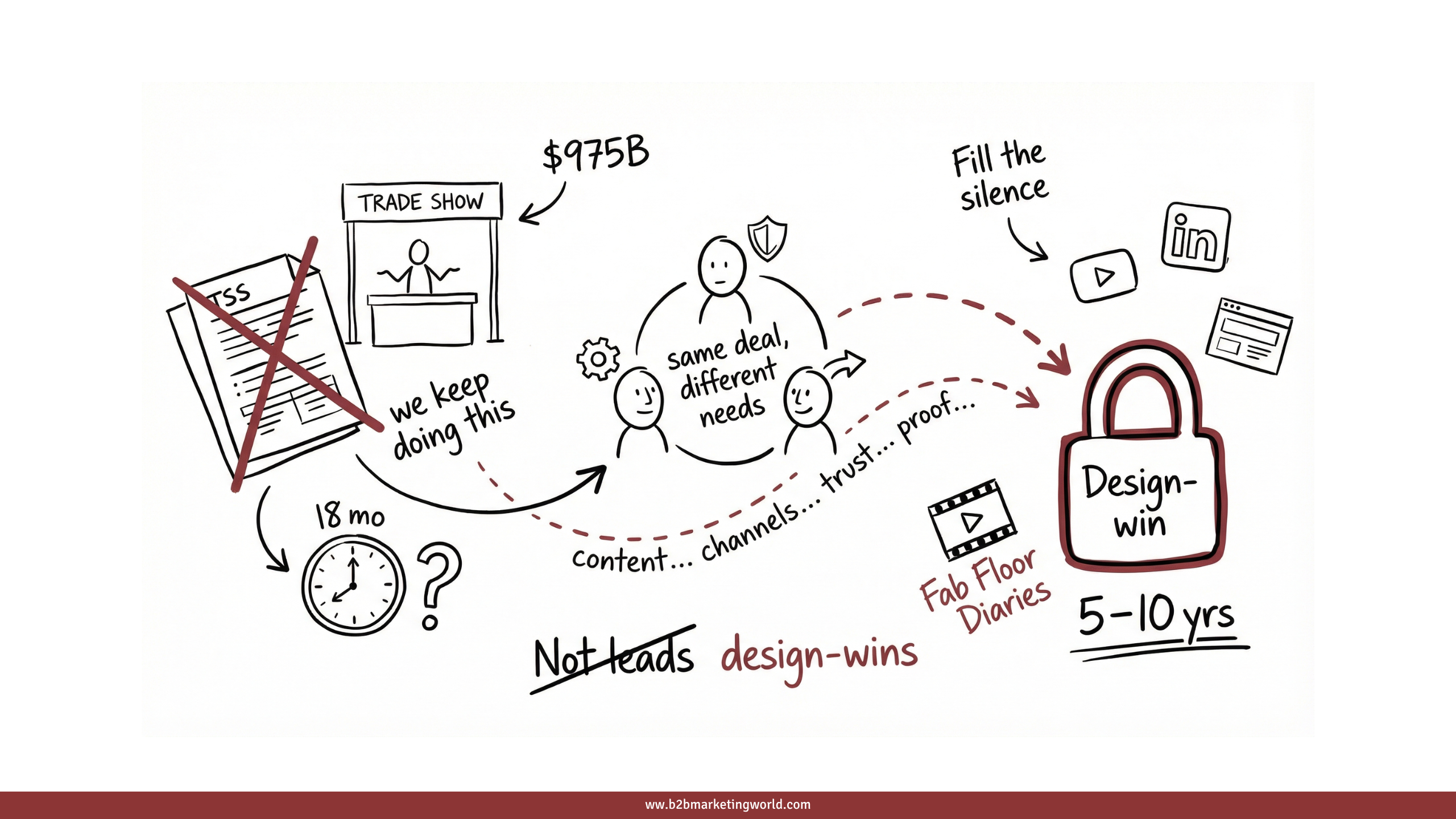
The semiconductor industry is racing toward $975 billion in revenue – yet most semiconductor marketing is fighting with one-person teams, content that reads like a spec sheet, and buying cycles so long that proving ROI feels like guesswork.
The problem isn’t effort.
It’s that conventional B2B marketing breaks when your buyers are split between engineers, procurement, and C-suite – each wanting different proof, on different timelines, through different channels. Add geopolitical shifts that keep redrawing your audience map, and the playbook most companies rely on stops working entirely.
But the companies getting this right are winning design-ins that lock in revenue for a decade.
This article shows you how:
- the five structural barriers to fix first,
- the channels that actually influence qualification decisions,
- a framework for marketing around the design-win model,
- and a ready-to-adapt campaign blueprint built for how semiconductor buyers really make choices.
Semiconductor Marketing © B2B Marketing World
A $975 Billion Market
Where Most Companies Still Rely on Handshakes and Trade Show Booths
The global semiconductor industry hit $772 billion in revenue in 2025 and is projected to approach $975 billion in 2026 (Deloitte). AI chips alone account for roughly half of all revenue yet represent less than 0.2% of total chip volume – meaning a handful of buyer relationships drive outsized value.
Yet the industry’s marketing hasn’t kept pace.
Most semiconductor manufacturers operate with one- or two-person marketing teams expected to cover strategy, content, trade shows, and sales enablement.
Digital spending hovers around 36% of the marketing budget, well below other B2B sectors – even as buyers increasingly research online before engaging sales. And 66% of manufacturers say their own content doesn’t prompt action.
The timing makes this gap costly. The CHIPS Act, European Chips Act, and programs in Japan and South Korea are creating new fabs and entirely new buyer relationships.
Companies that can’t market beyond their existing networks will watch the reshoring wave pass them by.
Why Marketing Feels Impossible Here
The Structural Barriers That Keep Semiconductor Companies Stuck
Semiconductor marketing doesn’t fail because teams lack effort. It fails because the industry has structural characteristics that break conventional B2B playbooks.
We look at:
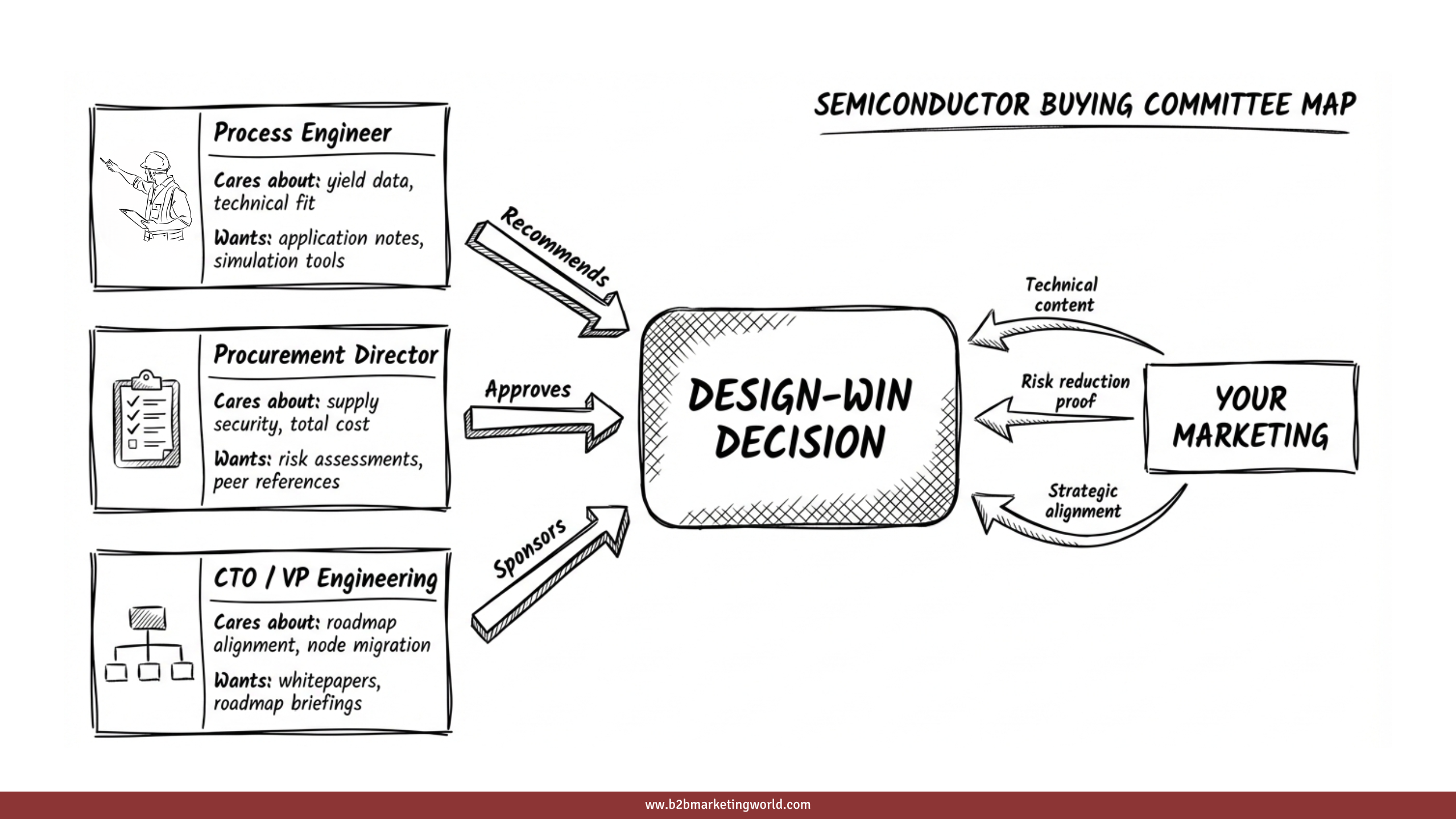
The buyer committee has engineers, procurement, and C-suite. And they want different things.
A single purchasing decision can involve process engineers evaluating yield data, procurement directors assessing supply chain resilience, and CTOs weighing roadmap alignment. Each stakeholder filters your message through a completely different lens.
| Buyer role | Primary concern |
|---|---|
| Process engineer | Technical fit, yield reliability |
| Procurement director | Supply security, total cost of ownership |
| CTO / VP Engineering | Roadmap alignment, node migration path |
Marketing that speaks to only one of these roles loses the deal at another desk.
Semiconductor Buying Committee Map © B2B Marketing World
Twelve-month qualification cycles mean your campaign won’t show ROI this quarter
Qualifying a new supplier in semiconductor manufacturing takes 12–24 months (SpendEdge). That timeline makes standard demand-gen metrics — MQLs, pipeline velocity, quarterly attribution — nearly meaningless. Leadership teams that expect marketing to prove ROI in 90 days will starve programs that need 18 months to mature.
“Our content is too technical” is the wrong diagnosis — it’s too feature-focused
The real problem isn’t complexity. Engineers expect technical depth. The problem is framing. Spec sheets and feature lists dominate semiconductor content, but buyers need problem-oriented narratives: how does this solve a yield issue, reduce contamination risk, or ease a node transition?
When content is organized around the buyer’s challenge rather than the product’s features, engagement follows. This is where a well-defined content marketing strategy makes the difference — shifting from feature-led collateral to educational, problem-first content that builds trust and thought leadership.
Geopolitics keeps rewriting the audience map
U.S. export controls, CHIPS Act incentives, and China’s self-sufficiency push are constantly reshifting which geographies and buyers matter (Publitek). A marketing strategy built around stable regional demand breaks when trade policy redirects entire supply chains. Teams need messaging frameworks flexible enough to pivot when the next round of restrictions drops.
Semiconductor Marketing Channels
Which Marketing Channels Actually Move Decisions in Semiconductor Manufacturing
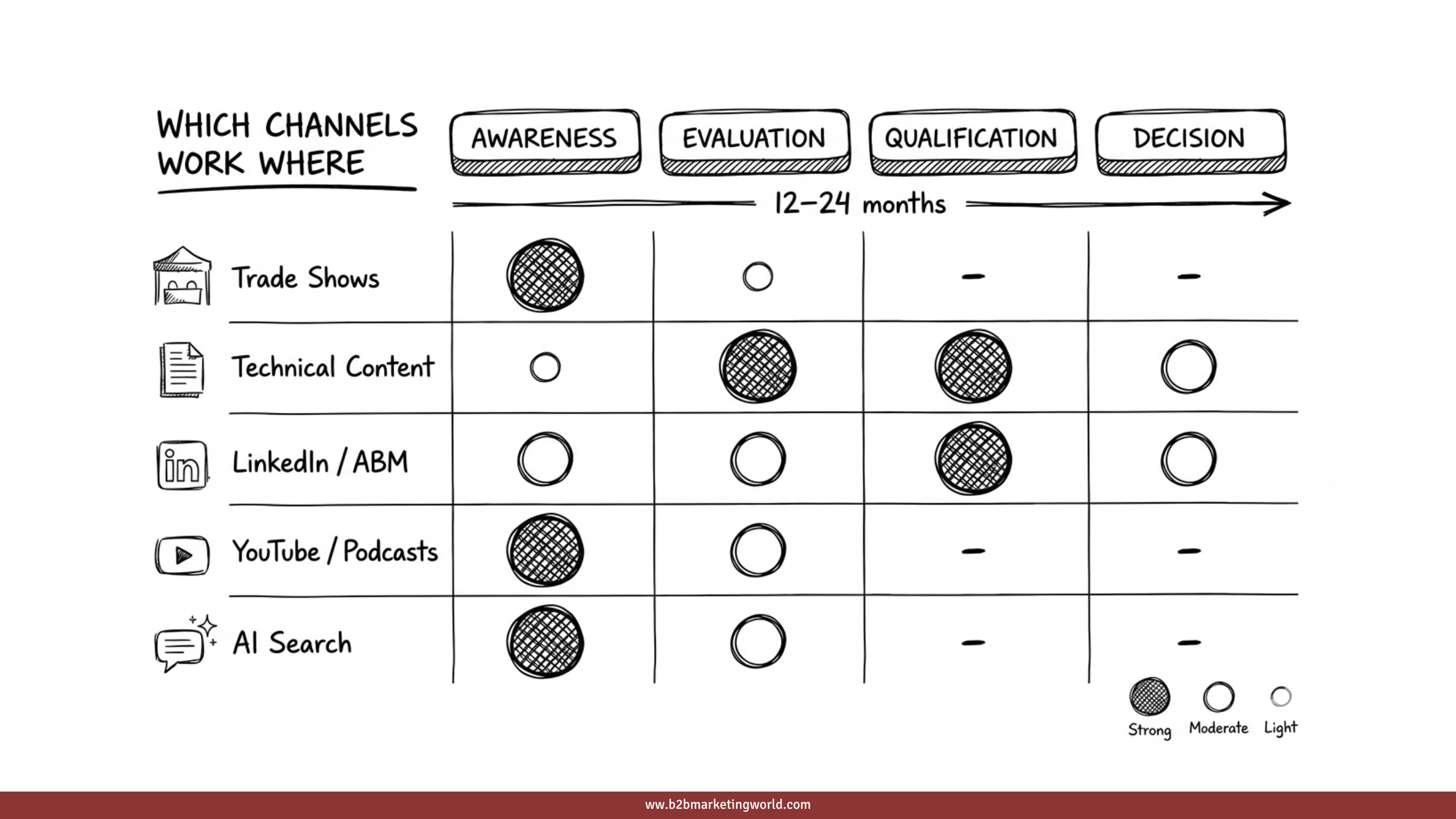
Not every channel works the same way in a market where trust is built through technical validation and multi-year relationships. The key is matching the right channel to the right stage of a buying process that can stretch well over a year.
Top Channels to focus on:
Channels in Semiconductor Manufacturing Marketing © B2B Marketing World
Ok guys, let us have a closer look on each of these marketing channels:
The emerging channels: AI search, video, and podcasts
Buyers are increasingly using AI tools like ChatGPT and Perplexity for early-stage research. Companies with well-structured, technically rich content are more likely to surface in these AI-generated answers — a new form of visibility that most semiconductor marketers aren’t optimizing for yet.
| Channel | Best use in semiconductor marketing |
|---|---|
| YouTube / Technical Video | Explaining complex process technologies to engineers in evaluation mode |
| Industry podcasts | Building thought leadership with senior technical and business audiences |
| AI search | Capturing early-stage research queries from engineers and procurement |
How the Semiconductor Sales Model Shapes Marketing Campaigns
Design-Win Marketing
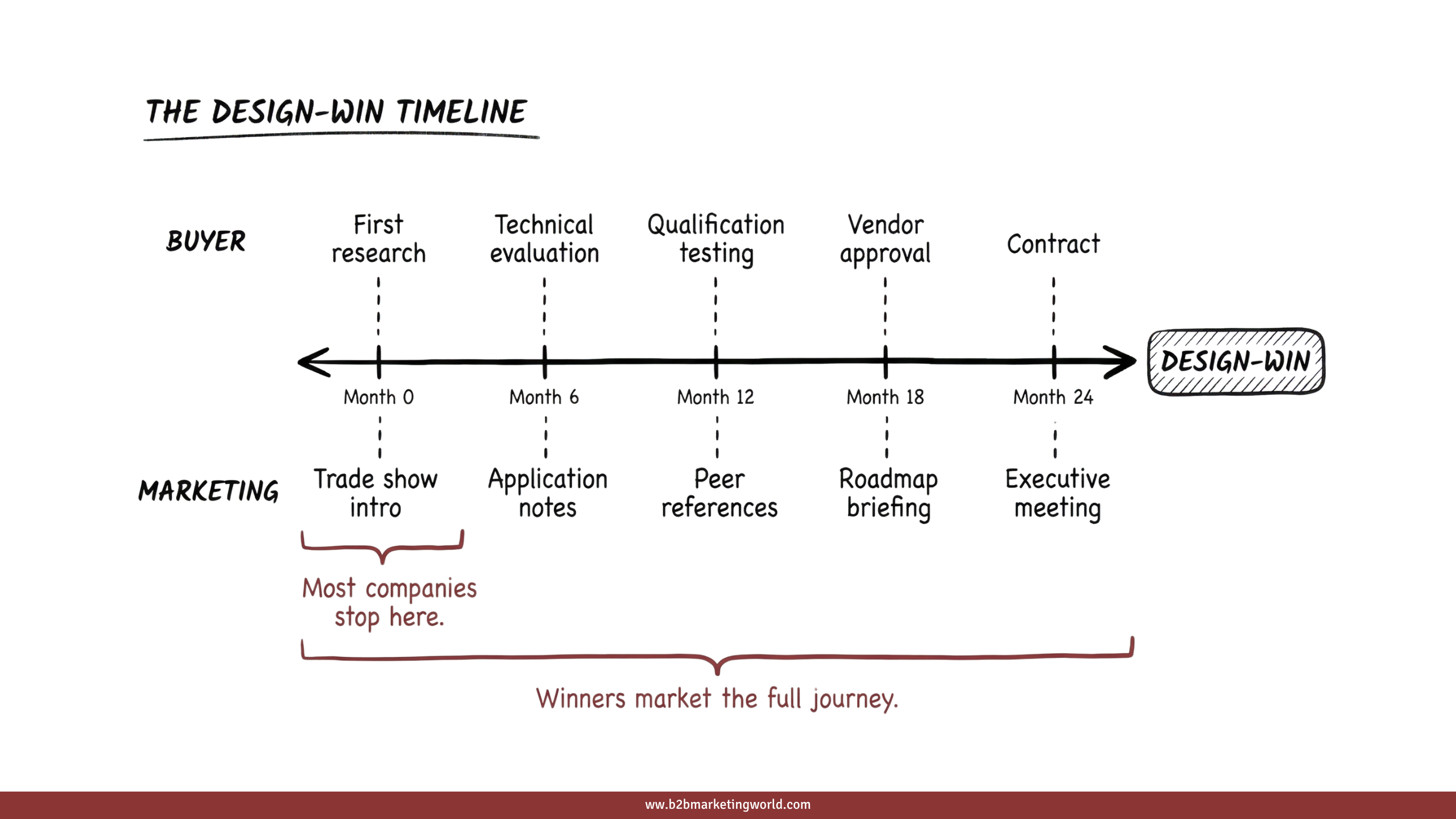
Most B2B marketing frameworks are built around a funnel: generate leads, nurture them, close deals, repeat quarterly. Semiconductor manufacturing doesn’t work that way.
Semiconductor Marketing Timeline © B2B Marketing World
Here, the real prize is the design-win — the moment a buyer qualifies your equipment, material, or process technology into their production line. Once that happens, switching costs lock them in for years. A single design-in can sustain revenue for five to ten years.
That changes what “good marketing” looks like. The goal isn’t maximizing MQLs. It’s influencing qualification decisions long before procurement negotiations begin.
Trust is the prerequisite, not the byproduct. Buyers in this space commit enormous capital once they’ve decided. NVIDIA made $775 million in upfront payments to chipmakers in a single quarter to secure supply. That kind of commitment doesn’t follow a webinar download. It follows months — sometimes years — of technical validation, peer references, and consistent visibility. Marketing’s job is to build the foundation of credibility that makes those commitments feel safe.
Risk aversion is the dominant buyer emotion. Qualifying a new supplier takes 12–24 months of testing, auditing, and internal review. The default choice is always the incumbent — the known quantity that won’t cost anyone their job if something goes wrong. This means every campaign, every piece of content, and every touchpoint should systematically reduce perceived risk:
Geopolitics is creating an opening for challenger brands. The tension between “we’ve always worked with our incumbent” and mounting pressure to diversify supply chains is real. Export controls and reshoring incentives are forcing buyers to re-evaluate supplier relationships they haven’t questioned in decades (Publitek).
That’s a rare window for new entrants — but only for those who can address both the technical case and the geopolitical case for switching. Marketing that acknowledges the political reality while grounding the argument in performance data speaks to how these decisions are actually made today.
A Campaign Blueprint
for Semiconductor Companies Ready to Stand Out
Most semiconductor marketing looks the same: product datasheets, booth banners, and corporate webinars. Here’s an approach that breaks the pattern.
What to focus on here:
The Concept
A documentary-style content series — short video episodes paired with written deep-dives — that follows real process engineers through their daily cleanroom challenges. Yield troubleshooting. Late-night incident responses. Contamination puzzles. Node migration headaches. Each episode ties to an industry-wide challenge, not a product pitch.
Why it works
The people who influence design-in decisions aren’t procurement directors reading brochures. They’re engineers who trust other engineers. A series that shows authentic, unglamorous technical problem-solving earns credibility in a way that polished corporate content never will. It speaks their language — and in an industry drowning in spec sheets, that alone is a differentiator. This approach mirrors the best B2B marketing examples where companies like Maersk and Lincoln Electric succeed by giving their brand a human face and featuring real employees.
Distribution across three channels
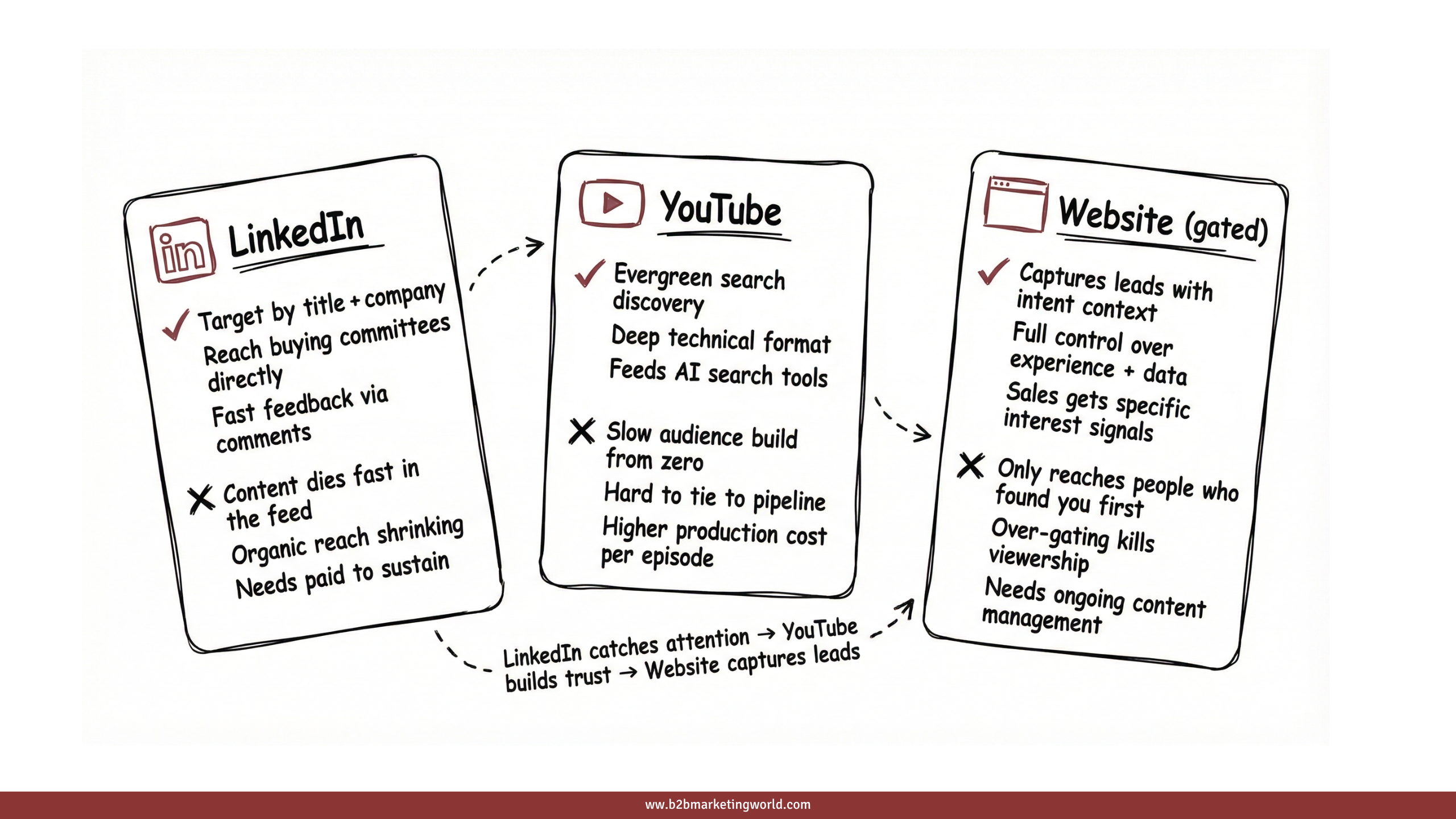
Semiconductor Marketing Campaign Channels © B2B Marketing World
Professional reach into buying committees.
LinkedIn is where semiconductor decision-makers already spend time. Post short episode clips (60–90 seconds) with a text summary highlighting the engineering challenge featured.
Use LinkedIn Ads to target by job title and company, pushing episodes directly to process engineers, procurement directors, and engineering VPs at your key accounts. Encourage your own engineers to share and comment — peer-to-peer engagement from real technical staff outperforms any branded post. Over time, the series builds a content library that supports account-based marketing campaigns tied to specific prospect companies.
Long-form discovery and evergreen search visibility
Full-length episodes (8–15 minutes) live on YouTube, optimized with titles and descriptions that match how engineers actually search: “improving oxide etch uniformity,” “reducing particle contamination in 300mm fabs,” or “HBM packaging yield challenges.”
This is content that surfaces months or even years after publishing — engineers searching for solutions to specific process problems find your brand at the exact moment they’re looking for answers. YouTube also feeds AI search tools like ChatGPT and Perplexity, giving your content a second discovery path that most semiconductor companies aren’t capturing yet.
Lead capture for high-intent viewers
Host the complete series on a dedicated microsite with full episodes, written companion articles, and downloadable process insights. Gate the deeper technical resources — extended data sets, methodology breakdowns, or expert Q&A transcripts — behind a simple form. Viewers who arrive here from LinkedIn or YouTube have already self-qualified through engagement.
This is where passive viewers become identifiable leads that your sales team can act on, with context about which specific engineering challenges they care about. Building this journey effectively requires a well-structured marketing funnel that maps content to each stage of the buyer’s decision process.
The double payoff
The same content that builds buyer trust also works as employer branding. In an industry facing a shortage of over one million specialists by 2030, showcasing real engineering culture attracts the talent pipeline alongside the sales pipeline.
No product names. No vendor pitch. Just insider credibility — the scarcest currency in semiconductor marketing.
Summary [TL;DR]
The gap: A $975 billion industry where most companies still market with trade show booths, spec sheets, and one-person teams. Digital spend lags behind other B2B sectors, and 66% of manufacturers say their content doesn’t prompt action.
The four barriers: Buying committees with competing priorities. 12–24 month qualification cycles that break quarterly attribution. Feature-focused content instead of problem-focused content. Geopolitics rewriting the audience map. All compounding at once.
The channels that matter:
The key insight: Semiconductor marketing isn’t about generating leads. It’s about winning design-ins — qualification decisions that lock in revenue for 5–10 years. Every campaign should reduce perceived risk, build trust through technical validation, and address both the performance case and the geopolitical case for choosing you.
One campaign to steal: “The Fab Floor Diaries” — documentary-style content following real engineers through real cleanroom challenges. No product pitch. Distributed via LinkedIn, YouTube, and gated on-site. Builds buyer trust and employer brand simultaneously.

Stephan Wenger
B2B Marketing Expert, Editor and Marketing Management Consultant
Stephan Wenger is a seasoned B2B Marketing Expert with more than 15 years of experience in leading global companies. His extensive expertise lies in the realms of B2B online marketing, content marketing, strategic marketing, and driving synergy between sales and marketing, including effective lead management.
You May Like the Following Articles

Steel Supplier Marketing
This article reframes steel marketing as a decision-support system. See how early signals shape shortlists, how different buying roles rely on marketing to reduce risk, where common approaches fail, and what changes when marketing is built to support approvals instead of attention.
B2B Agricultural Machinery Marketing
Selling tractors, harvesters, or plows isn’t a quick process. Buyers take time, involve multiple decision-makers, and require a solid financial commitment. This is a full guide on B2B agricultural machinery marketing, including real-world examples from John Deere and Kubota.
B2B Construction Machinery Marketing
This is your guide to create a B2B marketing construction machinery roadmap + 3 Examples. Marketing in the construction machinery industry is complex but essential. Unlike consumer goods, purchasing decisions for heavy equipment like excavators, bulldozers, and loaders involve multiple stakeholders, long sales cycles and significant investments. This article provides a structured approach to B2B marketing for the construction machinery industry.
B2B Fintech Marketing
B2B fintech marketing promotes financial technology products to other businesses. It’s different from consumer marketing because the target group is companies like banks, insurance firms, and financial institutions. In this article, we explore the foundations of B2B fintech marketing. We look at key strategies, challenges, and how to measure success. We also discuss future trends that will shape this industry.
B2B Manufacturing Marketing
B2B manufacturing marketing involves promoting products and services from one business to another within the manufacturing sector. Key Points are: Complex Buying Process, Emphasis on Relationships, Technical Focus. This blog post will explore the unique aspects of B2B manufacturing marketing, its challenges, and effective strategies for overcoming them.
Build a B2B Marketing Funnel
Build a B2B marketing funnel requires 5 steps: creating a customer journey, mapping marketing channels, building a multi-touch attribution model, establishing and measuring KPIs, and constantly adapting the funnel. Read how to do this and learn that marketing and sales alignment are essential.
First 90 days for a B2B CMO
In this guide, I’m going to share with you 11 steps to take in the first 90 days of your cadence if you join a B2B company with a high ACV product as a new CMO. As a new chief marketing officer in a B2B company, it's important to hit the ground running and establish a strategy for aligning marketing and sales efforts.