
The Hidden Cost of “Good Enough” AI Writing in B2B Marketing
A Real World Example
No time? Read Summary
AI writing tools have transformed B2B marketing teams almost overnight. Blog posts, landing pages, emails, and sales collateral that once took weeks can now be produced in hours. For lean teams under pressure to scale content, the efficiency gains are undeniable.
But speed has quietly reset expectations. Content that reads well enough, passes a surface-level review, and ships on time is increasingly considered a success.
The problem is that “good enough” language carries hidden costs – particularly in B2B environments where trust, clarity, and credibility directly influence buying decisions. Let’s see details on AI writing in B2B marketing.
Fluency is not accuracy
Most AI-generated content today is fluent. Grammar is correct. Sentences sound professional. Terminology appears appropriate. On the surface, nothing feels wrong.
Yet fluency often masks deeper issues:
- Subtle shifts in meaning
- Loss of emphasis or intent
- Inconsistent terminology
- Tone that drifts from brand expectations
In B2B marketing, these details are not cosmetic. A softened product claim, an imprecise qualification, or a tonal mismatch can undermine confidence. Especially among senior buyers and enterprise stakeholders.
AI does not understand risk or intent. It predicts language based on likelihood, not business context. When teams treat fluency as a proxy for accuracy, they introduce uncertainty into their messaging.
A real-world example: when “good enough” quietly changes the message
A European B2B technology company we worked with relied heavily on AI to accelerate content localisation during an international expansion. The workflow was efficient: produce English copy, translate it automatically, perform a quick review, and publish across multiple markets.
At first glance, the translations looked fine. Grammar was correct. Sentences flowed naturally. Nothing appeared broken enough to justify delaying publication.
The problems only surfaced when the content was examined more closely.
The issue surfaced during an internal language review process I was involved in through my work with LanguageCheck.ai, where AI-generated content is examined specifically for semantic and tonal shifts rather than surface-level fluency.
In one instance, an English sentence meant to convey emotional restraint—“He smiled politely, trying not to show how deeply the remark had hurt him”- was translated into Italian using language that implied mild irritation rather than emotional pain. The intensity of “how deeply” disappeared. What was meant to signal vulnerability became emotionally neutral.
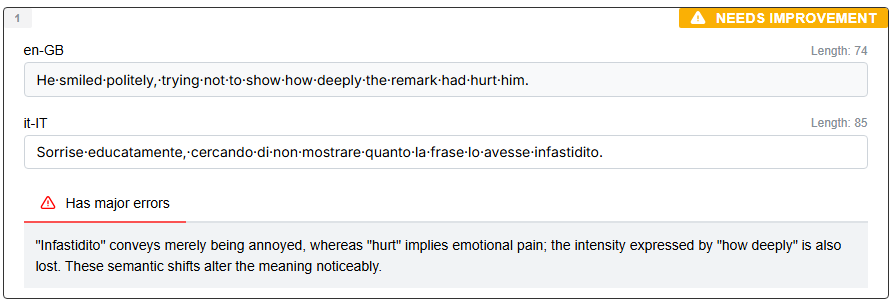
AI Writing in B2B Marketing Example © LanguageCheck.ai
In another passage, a metaphor describing memories speaking through a character was translated as memories speaking to them. The sentence still sounded natural, but the perspective and imagery changed. The original intent was lost, even though nothing appeared “incorrect.”
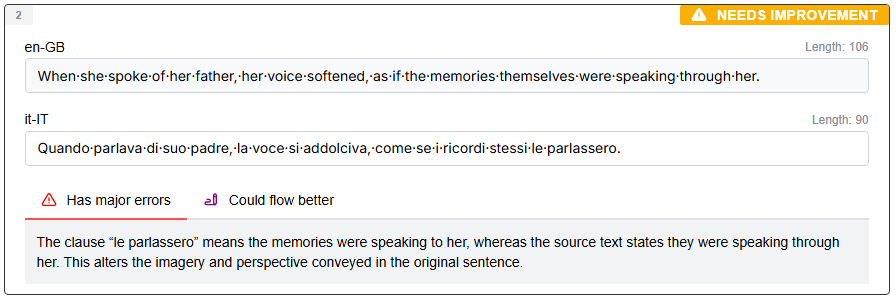
AI Writing in B2B Marketing Exampl © LanguageCheck.ai
Individually, these changes seemed minor. Collectively, they revealed a larger issue: the content no longer said what the company believed it was saying.
The impact became visible when a regional marketing lead flagged that the localised content felt emotionally flat and inconsistent with the brand’s positioning. Nothing was factually wrong, yet the messaging lacked the nuance and precision expected from a premium B2B brand.
The team paused distribution and reviewed their process. They realised their approval checks focused on correctness and readability – not on meaning, tone, or narrative intent. Native speakers hadn’t raised concerns because the language wasn’t obviously flawed. AI hadn’t flagged the issues because it cannot evaluate emotional weight or semantic drift.
The fix wasn’t abandoning AI. It was recognising that “publishable” does not mean “accurate enough for brand trust.”
Brand damage happens quietly
Unlike factual errors, language quality issues rarely trigger immediate alarms. There is no dashboard for tonal drift. No alert for diluted meaning.
Instead, the effects accumulate:
- Enterprise buyers question professionalism
- Sales teams rephrase messaging in conversations
- Legal or compliance teams intervene late
- Regional audiences feel the content wasn’t written for them
Over time, credibility erodes—not because the message was wrong, but because it lacked precision.
In high-consideration B2B sales cycles, this erosion of trust is expensive.
The multilingual risk multiplier
The risks of “good enough” AI writing increase significantly outside English-first markets.
AI translations often preserve sentence structure while flattening nuance. Formality shifts. Industry-specific language blurs. Regulatory phrasing may translate literally without translating legally.
Many global B2B teams approve multilingual content based on English reviews alone. This creates blind spots where language sounds fine but subtly misrepresents intent in ways reviewers cannot easily detect.
Where efficiency is actually lost
AI is often positioned as a way to reduce workload. In practice, imprecise language shifts effort downstream.
Sales teams adjust messaging on the fly. Customer success teams clarify onboarding content after confusion arises. Legal teams rewrite claims that should have been precise from the start.
Time saved in drafting is quietly lost in correction.
What “good” looks like now
The most effective B2B teams aren’t rejecting AI. They’re redefining how it fits into their workflows.
Instead of asking, “Does this read well?”, they ask:
- Is the meaning unambiguous?
- Is the terminology consistent with how we sell?
- Would this wording hold up in a contractual discussion?
- Does this tone match the expectations of this market?
Teams that treat language quality as governance rather than polish move faster over time because they spend less energy fixing misunderstandings later.
Precision as a competitive advantage
As AI-generated content becomes ubiquitous, fluency will no longer differentiate brands. Precision will.
Clear language signals maturity. Consistent terminology builds confidence. Accurate tone reinforces trust in complex buying environments.
AI has made content easier to produce. That makes language quality more visible—not less important.
In B2B marketing, where credibility compounds over long sales cycles, “good enough” writing often costs more than teams realise.
Summary [TL;DR]
AI has made B2B content faster to produce, but “good enough” language hides real risk. Fluent text can still distort meaning, soften intent, or shift tone in ways that undermine trust with senior buyers.
These issues rarely trigger alarms, yet they quietly erode credibility. Especially in long, high-stakes sales cycles and multilingual markets. Teams often save time upfront, only to lose it later when sales, legal, or regional teams have to correct imprecise messaging.
The problem isn’t using AI; it’s treating readability as a proxy for accuracy. As AI content becomes ubiquitous, precision, not fluency, becomes the real competitive advantage in B2B marketing.
You May Like the Following Articles

The B2B Campaign That Cut Through The Noise With A Cardboard Box
In this B2B marketing use case, Halo Solutions cut through the AI-saturated noise by going physical. The Black Box Campaign mailed unannounced, story-driven boxes to hard-to-reach safety leaders, turning abstract risk into a felt experience.
The 30+ Best B2B Marketing Podcasts
Are you looking for the best B2B marketing podcasts that inform and inspire you? We have you covered. This article lists 30+ podcasts for B2B marketing. To make your decision easy, we added details such as the number of episodes, length of episodes, and a short description.