
Life Sciences Marketing
Why the Standard B2B Playbook Breaks Down and What Actually Works
No time? Read Summary
Life sciences marketing is broken. Not because the tools are wrong or the budgets are too small.
It’s broken because the standard B2B playbook was never built for an audience that peer-reviews your claims before reading your second paragraph.
Your buyers are PhDs, lab directors, and clinicians. They don’t click on “request a demo” because your ad told them to. They read 3 to 7 pieces of content before they even consider talking to sales.
And when they do engage, they bring 6 to 13 colleagues into the decision. Good luck convincing all of them with a single landing page.
Meanwhile, nearly 24% of companies are cutting senior marketing roles without lowering the performance bar. Fewer people, same expectations, harder audience.
This article breaks down why life sciences marketing plays by different rules, which channels actually earn trust with scientific buyers, and where to start when your team is stretched thin.
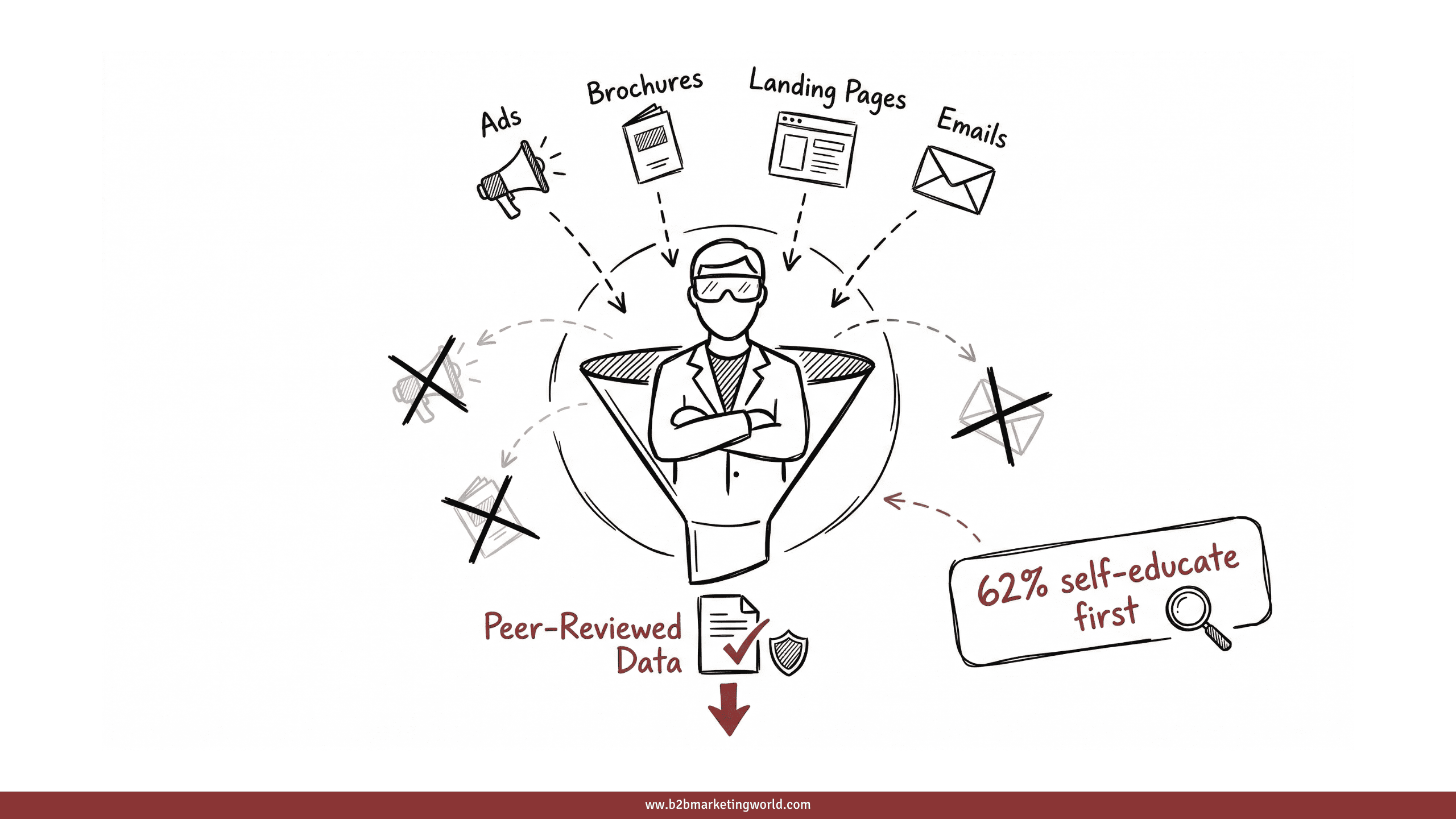
Life Sciences Marketing Expectations © B2B Marketing World
Scientists Don’t Trust Marketing
Most B2B industries deal with skeptical buyers. Life sciences operates on a completely different level. Your audience isn’t just cautious. They’re trained to be skeptical. Peer review, evidence hierarchies, statistical significance: these aren’t buzzwords for them. It’s how they think. Every day. About everything.
13 Stakeholders, One Decision
How Life Sciences Buying Committees Stall Deals
You’ve built a great piece of content. The right person reads it. They’re interested. And then… nothing happens for 6 months.
Welcome to life sciences B2B, where the person who loves your product is rarely the person who signs the check.
What to focus on here:
The Buying Committee Is Bigger Than You Think
According to Gartner, a typical buying group for a complex B2B solution involves 6 to 10 decision-makers. Forrester puts that number even higher at 13 stakeholders on average, spread across multiple departments.

Influence of the Life Sciences Buying Center © B2B Marketing World
Each of them brings their own research, their own priorities, and their own reasons to say no. Understanding your B2B marketing funnel and how these stakeholders move through it is essential to avoid stalled deals.
In life sciences, that committee looks something like this:
| Role | What they care about | Content they need |
|---|---|---|
| C-suite / Finance | ROI, strategic fit, budget impact | Executive summaries, financial models |
| KOLs / Principal Investigators | Scientific validity, peer evidence | Peer-reviewed data, clinical results |
| Lab Managers / Technical Buyers | Workflow integration, usability | Application notes, product demos |
| Procurement / Compliance | Regulatory risk, contract terms | Compliance documentation, certifications |
| End Users | Daily usability, learning curve | Tutorials, onboarding guides |
One message doesn’t work for this group. One content format doesn’t either.
“No Decision” Beats Your Competitor More Often Than You’d Expect
Here’s a stat that should change how you think about your pipeline: over 40% of B2B deals stall because internal stakeholders fail to align (AdvanceB2B). Not because a competitor won. Not because the budget disappeared. The committee simply couldn’t agree.
That means your biggest competitor isn’t the other vendor. It’s indecision.
Each Stakeholder Speaks a Different Language
A CFO asks “what’s the return?” A researcher asks “where’s the data?” A lab manager asks “does it fit our workflow?” These aren’t variations of the same question. They’re fundamentally different concerns. And if your marketing only answers one of them, the deal stalls with the others.
This is where most life sciences marketing teams fall short. They produce content for the researcher because that feels natural. But they forget that the person who influences the deal is not always the person who approves it.
Meanwhile, sales rep access to health systems continues to decline (ZS), which means marketing is often the only voice in the room before any human conversation happens. This dynamic is why lead management — the process of generating, nurturing, and qualifying leads across both marketing and sales — becomes mission-critical in life sciences.
Fair enough. But this only works if you know who’s sitting at that table. And most teams don’t map their buying committees until it’s too late.
Marketing Channels That Work When Your Buyer Has a PhD
Knowing that your audience is skeptical and your buying committee is large doesn’t help much if you’re spending your budget on the wrong channels.
And in life sciences, “wrong” often just means “borrowed from a SaaS playbook without adjusting for the audience.”
So which channels actually earn attention from scientists, researchers, and healthcare professionals? The answer isn’t surprising. But the reasoning behind it matters more than the list itself.
Here they are:
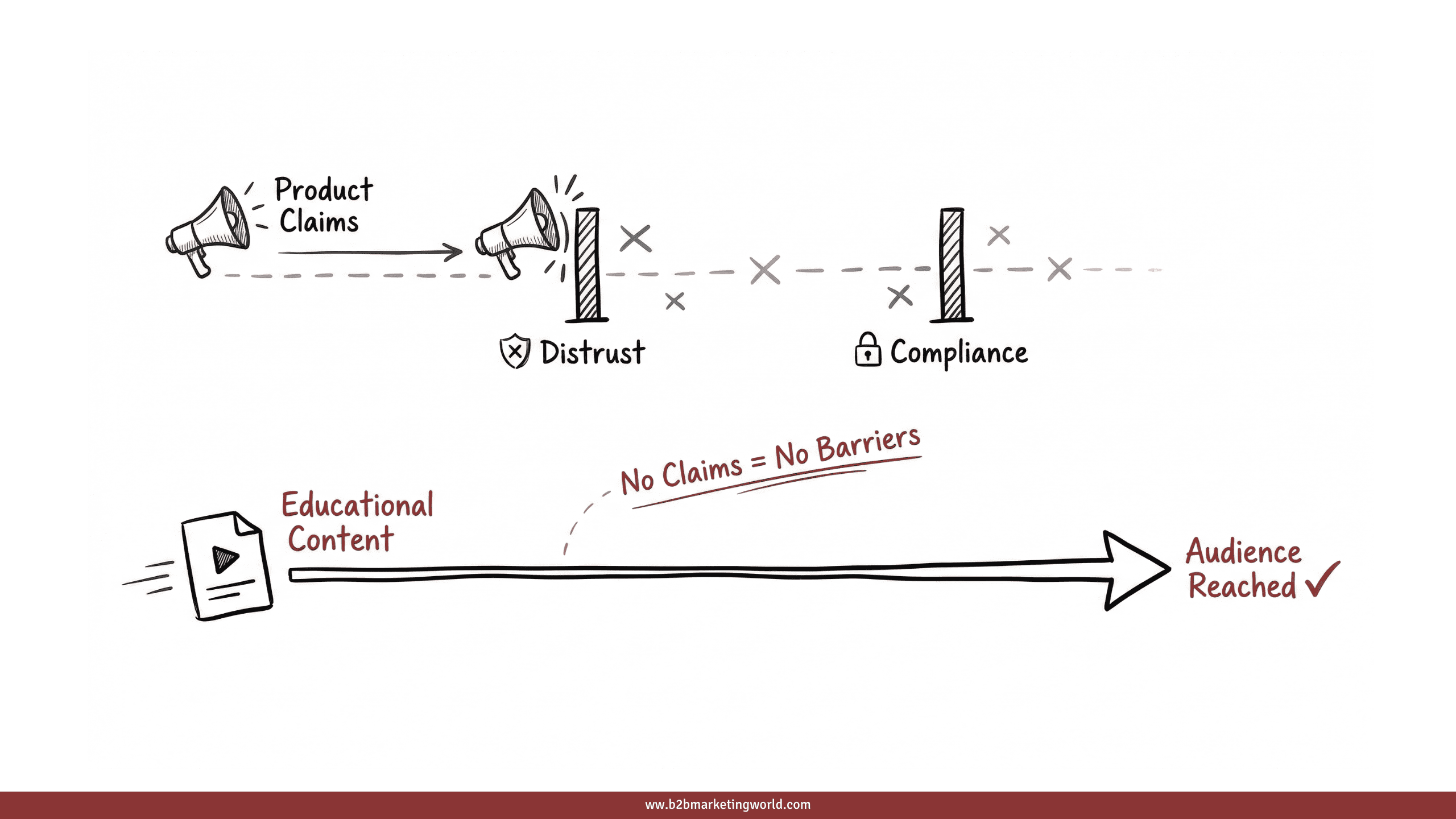
How Educational Content Helps to Reach The Audience Without Classic Marketing Barriers © B2B Marketing World
Branded Podcast: Marketing for Life Sciences
Everything in this article so far points to one core problem: scientists don’t want to be marketed to. They want to learn, discover, and connect with the work. So what happens when a life sciences company stops talking about its products entirely and starts telling the stories of the people behind the science?
Thermo Fisher Scientific did exactly that. Their podcast series doesn’t pitch products. It profiles scientists. Career journeys, research challenges, the human side of working in a lab. No promotional CTAs. No feature comparisons. Just conversations that scientists actually want to listen to.
Podcast as Life Sciences Marketing Channel © Spotify / Thermo Fisher Scientific
And that’s why it works.
It builds brand affinity without ever triggering the “this is an ad” reflex.
There’s a practical bonus too. Because the content makes no product claims, it sidesteps the regulatory compliance bottleneck that slows down almost every other marketing format in life sciences. No legal review of promotional language. No FDA concerns. Just educational content that happens to carry your brand.
Each episode becomes a reusable asset: social clips, newsletter features, blog summaries, conference talking points. The content compounds over time instead of expiring after one campaign cycle.
That’s rare in an industry where most marketing materials have a short shelf life due to regulatory updates and product changes. This concept of content compounding is central to an effective B2B content marketing strategy — whether you choose podcasts, white papers, or educational video.
The takeaway isn’t “start a podcast.”
It’s this: when your audience resists being sold to, stop selling and start being useful. The format matters less than the shift in intent.
What Works in Life Sciences Marketing in 2026
Nearly 24% of brands are cutting senior marketing roles without reducing expectations (Marketing Week, 2025). The teams are shrinking. The job isn’t. So let’s skip the theory and go straight to what to do, in what order.
The waterfall logic looks like this:
Buying committee map → content audit against the map → targeted channel selection.
Each step feeds the next. Skip one and the rest falls apart. Go back to Step 1 when deals stall and you don’t know why. Go back to Step 2 when content exists but doesn’t convert. Go back to Step 3 when reach is fine but engagement is flat.
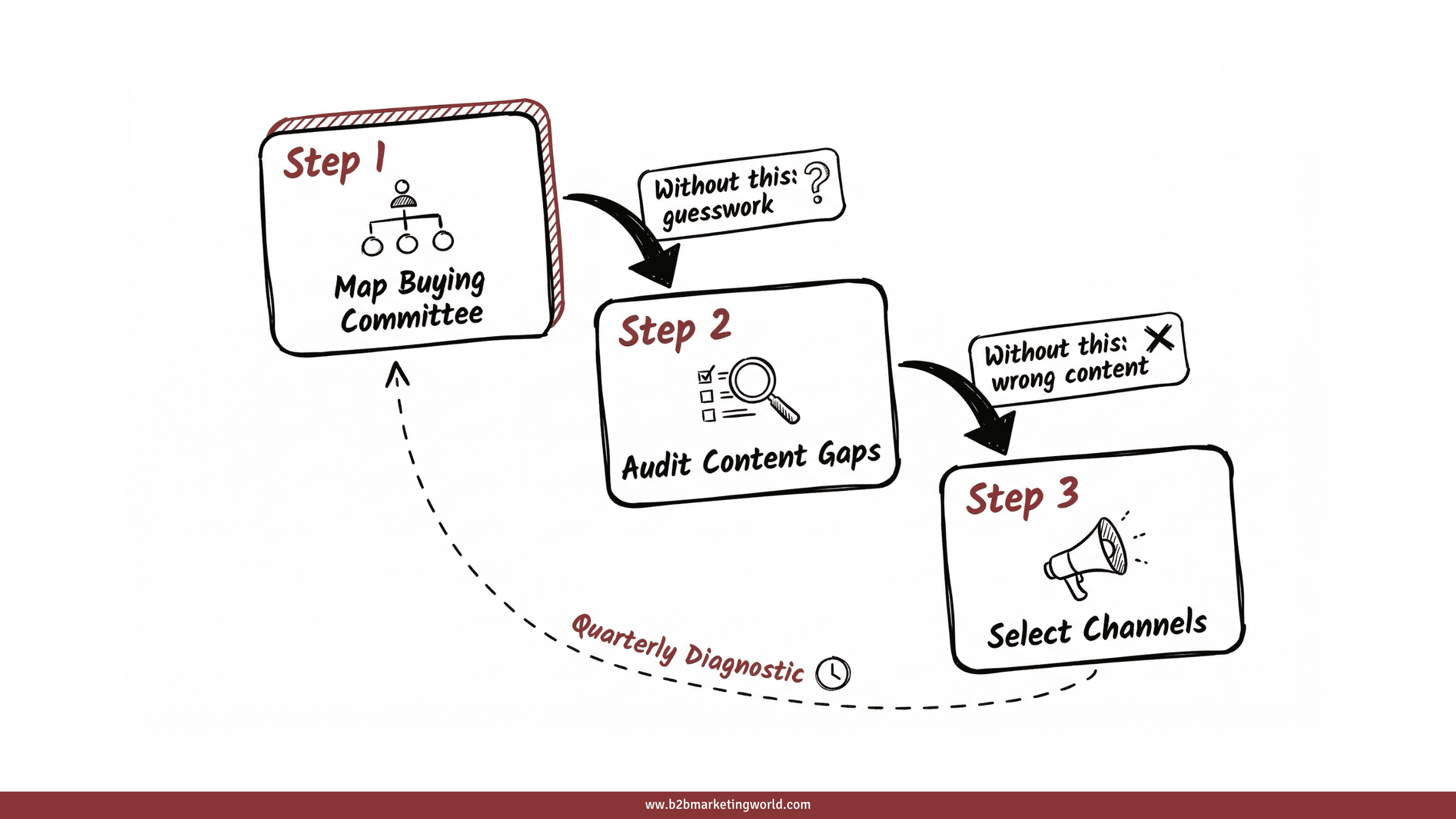
Buying Committe Mapping © B2B Marketing World
That’s the diagnostic built into the sequence. It’s not just a launch plan. It’s a troubleshooting framework you can run every quarter.
The biggest risk for life sciences marketing teams isn’t choosing the wrong tactic.
It’s doing too many things at 30% instead of 3 things at 100%.
Summary [TL;DR]
You sell to scientists. That changes everything.
Your buyers peer-review your content before they’ll even talk to sales. They read 3 to 7 pieces before engaging. They bring 6 to 13 colleagues into every decision. And over 40% of those deals don’t stall because a competitor won. They stall because the buying committee couldn’t agree.
If you take nothing else from this article, take these 5 things:
- Your audience is trained to distrust marketing. Peer-reviewed evidence, real data, and scientific rigor aren’t nice-to-haves. They’re the entry ticket. Anything that reads like a brochure gets dismissed.
- Your biggest competitor is “no decision.” Buying committees in life sciences are large, cross-functional, and slow. If your content only speaks to one role, the deal dies with the others.
- Proven channels still carry the weight. Email, webinars, white papers, and conferences aren’t exciting. They work. Especially when you segment by role and treat conferences as 3-phase campaigns, not booth rentals.
- Stop selling. Start being useful. The branded podcast model proves it: when you tell the stories scientists care about instead of pitching products, you bypass the trust barrier and the compliance bottleneck at the same time.
- Follow the waterfall. Map the buying committee first. Audit your content against that map second. Choose channels third. Each step feeds the next. Skip one and the rest collapses.
The life sciences market is projected to nearly triple by 2034 (Precedence Research). The opportunity is massive. But the teams chasing it are getting smaller, not bigger. Nearly 1 in 4 companies have cut senior marketing roles without lowering the bar.
That means you can’t afford to do everything. But you also can’t afford to guess.
Start with the buying committee. Build content that earns trust. Put it where your audience actually is. That’s not a theory. That’s a Monday morning action plan.
Life sciences marketing doesn’t need more tools. It needs more clarity. This article gave you the map.
Now use it.

Stephan Wenger
B2B Marketing Expert, Editor and Marketing Management Consultant
Stephan Wenger is a seasoned B2B Marketing Expert with more than 15 years of experience in leading global companies. His extensive expertise lies in the realms of B2B online marketing, content marketing, strategic marketing, and driving synergy between sales and marketing, including effective lead management.
You May Like the Following Articles

Semiconductor Marketing
Why semiconductor companies struggle to market, how most semiconductor marketers are fighting with one-person teams. This article shows you how: the five structural barriers to fix first, the channels that influence decisions, a framework for marketing around the design-win model, and a ready-to-adapt campaign blueprint.
Steel Supplier Marketing
This article reframes steel marketing as a decision-support system. See how early signals shape shortlists, how different buying roles rely on marketing to reduce risk, where common approaches fail, and what changes when marketing is built to support approvals instead of attention.
B2B Agricultural Machinery Marketing
Selling tractors, harvesters, or plows isn’t a quick process. Buyers take time, involve multiple decision-makers, and require a solid financial commitment. This is a full guide on B2B agricultural machinery marketing, including real-world examples from John Deere and Kubota.
B2B Construction Machinery Marketing
This is your guide to create a B2B marketing construction machinery roadmap + 3 Examples. Marketing in the construction machinery industry is complex but essential. Unlike consumer goods, purchasing decisions for heavy equipment like excavators, bulldozers, and loaders involve multiple stakeholders, long sales cycles and significant investments. This article provides a structured approach to B2B marketing for the construction machinery industry.
B2B Fintech Marketing
B2B fintech marketing promotes financial technology products to other businesses. It’s different from consumer marketing because the target group is companies like banks, insurance firms, and financial institutions. In this article, we explore the foundations of B2B fintech marketing. We look at key strategies, challenges, and how to measure success. We also discuss future trends that will shape this industry.
B2B Manufacturing Marketing
B2B manufacturing marketing involves promoting products and services from one business to another within the manufacturing sector. Key Points are: Complex Buying Process, Emphasis on Relationships, Technical Focus. This blog post will explore the unique aspects of B2B manufacturing marketing, its challenges, and effective strategies for overcoming them.