
Table of Contents
Subscribe to our Newsletter and Learn B2B Marketing.
Logistics industry marketing has a reputation problem.
Not with customers. With the companies that should be doing it.
According to Gartner’s B2B Buying Journey report, B2B buyers complete roughly 80% of their purchase research before they ever talk to you. If your marketing isn’t visible during that research phase, you’re not in the consideration set.
You know the drill. Sales closes deals. Marketing organizes the trade show booth and updates the website once a year.
That’s the reality in most logistics companies, and it’s been like this for decades.
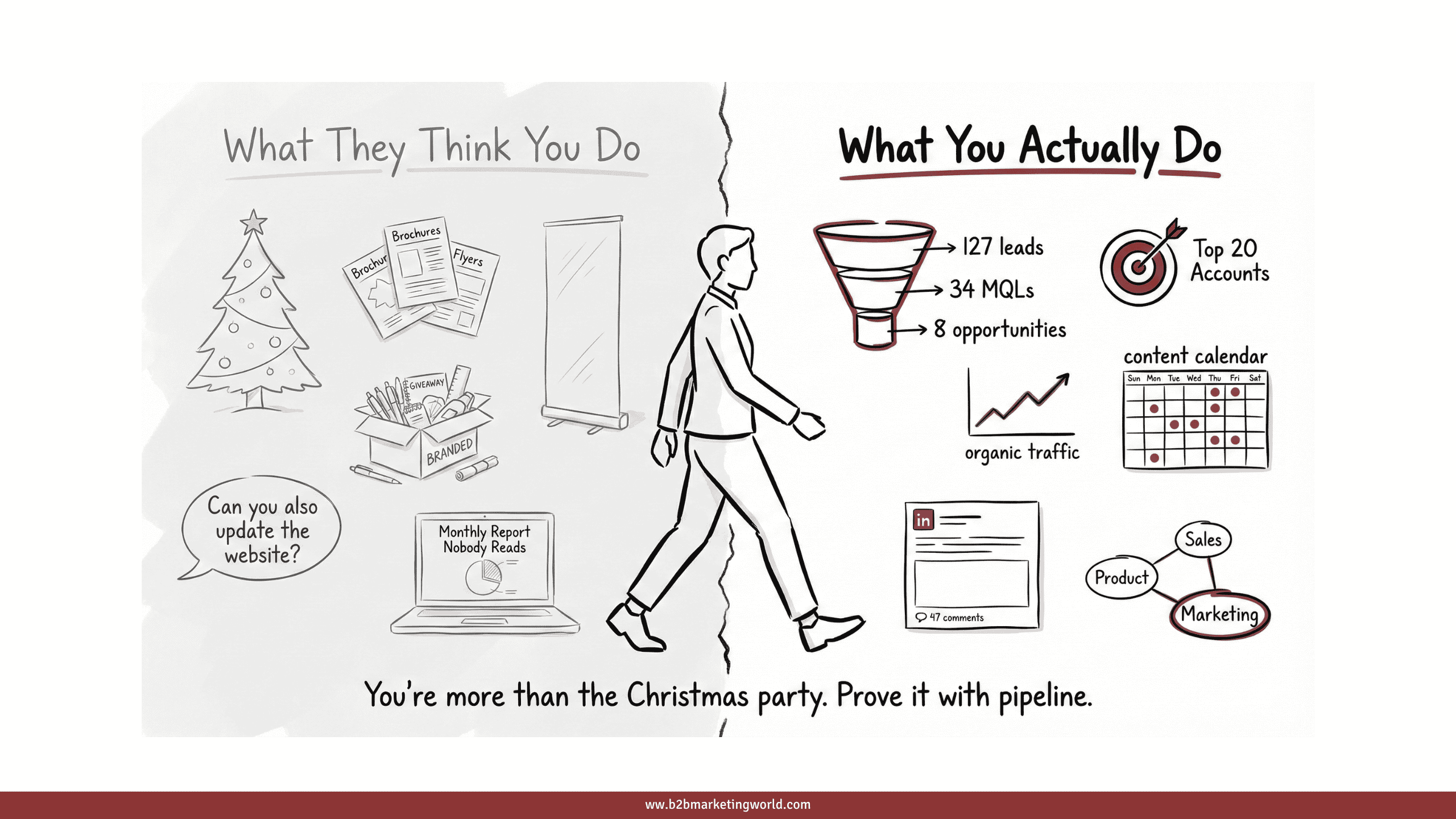
What they think you do – what you actually do in logistics industry marketing © B2B Marketing World
But this article isn’t doom and gloom. It’s about what actually works.
Maersk ran a campaign in 2023 that won a Drum B2B Award. They didn’t talk about shipping routes or container prices. They made the logistics professional the hero of the story.
This article breaks down:
- why logistics industry marketing is so hard,
- what buyers actually care about
- which channels and tactics deliver real results in 2026.
A practical playbook for logistics marketers who are tired of being treated like the team that plans the Christmas party.
You’re more than that. Let’s get into it.
Example: What Maersk got right
The Campaign That Turned Logistics Professionals Into Heroes
Most logistics companies market the same way.
Reliability. Global reach. Competitive rates. Maybe a stock photo of a container ship at sunset. It all blurs together.
In 2023, Maersk did something different. Instead of talking about what they ship, they told a story about the person managing it all. Their “From Chaos to Hero” campaign centered on Diana, a logistics professional navigating complexity and keeping supply chains running. Cinematic, adventure-style storytelling. 135 seconds. It won a Drum B2B Award.
Maersk Logistics Marketing Campaign Video © Maersk
But the award isn’t the point. What Maersk understood about their buyer is.
Logistics professionals don’t want to be reminded of the chaos they deal with every day. They already live it. They need a brand that makes them feel capable, strategic, and recognized.
Maersk is just one of several great B2B marketing examples worth studying.
This wasn’t just a creative gamble. It was a strategic repositioning from shipping company to logistics partner. According to The Drum, the campaign achieved a 4% increase in brand favorability (double the initial target) and a 46% month-over-month increase in share of voice in integrated logistics. The storytelling served the strategy, not the other way around.
The obvious objection: “That’s Maersk. They have the budget. We’re a mid-size 3PL with 2 people in marketing.”
Fair enough. But the principle doesn’t require a Hollywood budget. It requires a mindset shift. Most logistics companies market their capabilities. We do this, we cover that, we’re reliable. Every website, every pitch deck, every booth looks the same. The company that breaks this pattern wins attention simply because everyone else refuses to.
Dare to be different doesn’t mean being flashy. It means asking a better question: instead of “what do we want to say about ourselves,” ask “what does our buyer want to feel when they choose us?”
In an industry where everyone markets like a commodity, the company that markets like a brand wins trust before the first sales call happens.
That’s the theory. In practice, it only works if you understand how logistics buyers actually make decisions.
What Logistics Buyers Actually Care About
What That Means for Your Marketing
Before jumping into channels and tactics, you need to understand how your buyers actually decide. Most logistics indsutry marketing is built on assumptions that don’t match reality.
What to focus on here:
Reliability Beats Price — But Only If You Can Prove It Before the First Call
Ask any logistics buyer what matters most, and reliability tops the list. Track record, consistency, on-time performance. Price matters. But it’s rarely the primary driver.
Yet most logistics marketing leads with cost. Competitive rates. Flexible pricing. Cost savings.
| What most logistics companies market | What buyers actually evaluate |
|---|---|
| Competitive pricing | Track record and reliability |
| Global coverage | Technology and visibility |
| Service offerings | Relationship quality |
| Company size and scale | Proof points and references |
Reliability is the qualifier, price is the tiebreaker. If your marketing doesn’t prove reliability first, the price conversation never happens.
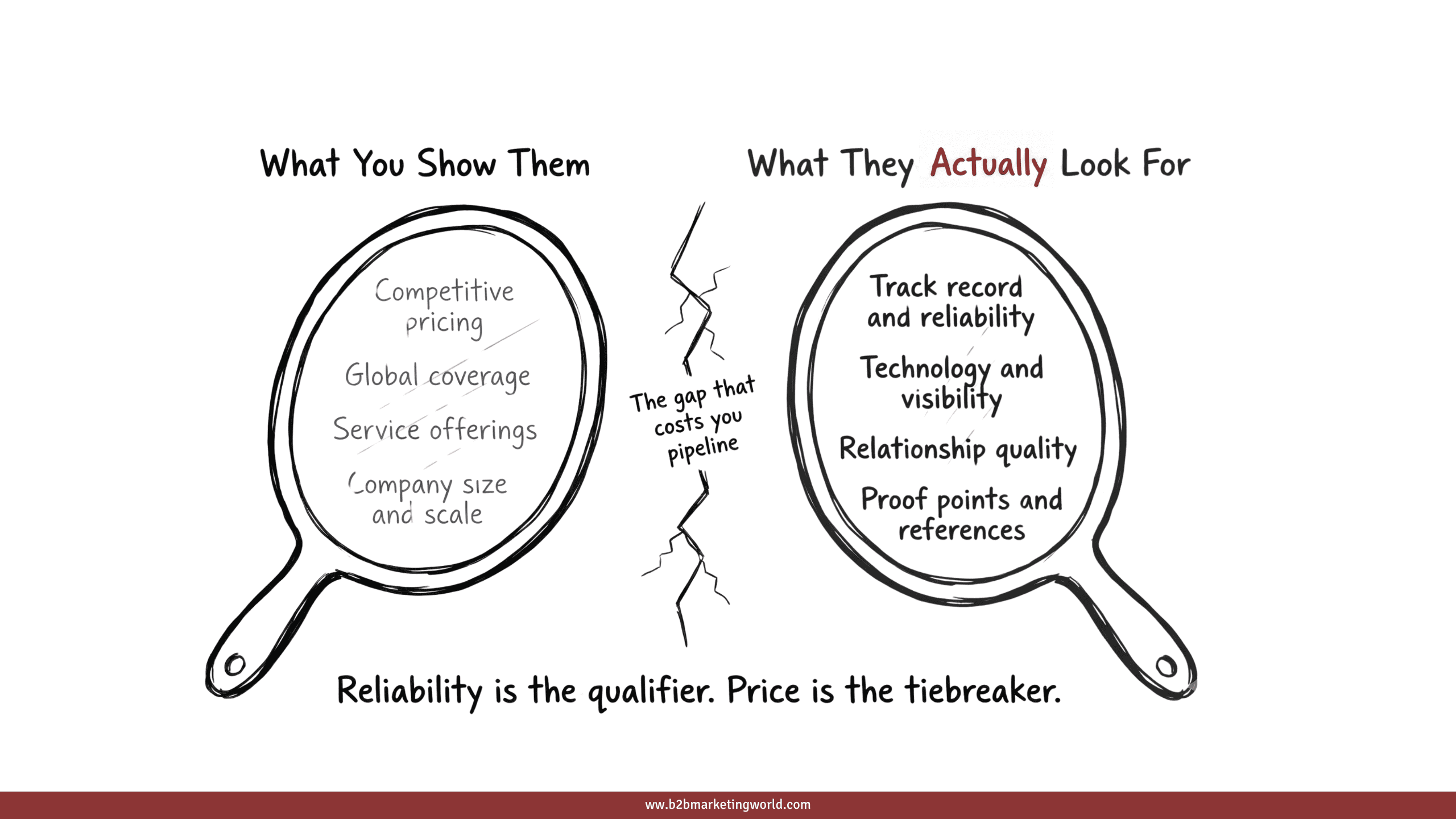
The missmatch in your logistics marketing approach compared to what buyers want © B2B Marketing World
According to Gartner, buyers complete roughly 80% of their research before they contact you. Your case studies, your content, your online presence need to build trust before you even know the buyer exists.
Referrals and word of mouth still dominate. Marketing’s job isn’t to replace that trust. It’s to amplify and scale it beyond your existing network.
And the investment is real: according to recent B2B marketing statistics, CMOs spent an average of 7.7% of total company revenue on marketing in 2024. That’s a third below the decade-long average of 10.3%, showing just how much budget pressure B2B marketers face.
The Switching Cost Advantage Most Logistics Marketers Ignore
Once a logistics provider is embedded in a client’s operations, switching is painful. Systems are integrated. Processes are calibrated. People know each other. It takes a major service failure or a significant price gap to trigger a change.
Most marketers see this as a problem. It’s actually an opportunity.
High switching costs mean your prospect needs proof that the risk of switching is worth it. Features and capabilities don’t move the needle. What does:
- Case studies showing measurable outcomes after switching
- Risk-reduction messaging (“here’s how we make the transition painless”)
- Third-party validation from trade press or industry analysts
- Peer references from comparable companies
The Buying Committee: Your Marketing Target
Logistics buying decisions are committee decisions. Procurement, operations, finance, logistics management. Each role evaluates differently, and most logistics industry marketing speaks to only one of them. Usually procurement. That’s a mistake. This buying center dynamic is a hallmark of B2B marketing as opposed to B2C, and it requires messaging tailored to each stakeholder.
The shift you can’t ignore: Millennials and Gen Z now hold real influence on these committees. They expect transparency, peer validation, and digital-first engagement. If your marketing still relies on PDF brochures and cold calls, you’re invisible to the people who increasingly shape the decision.
This leads to an obvious question. If buyers are this complex and the old playbook is breaking down… what replaces it?
The 2026 Logistics Industry Marketing Reality Check
Why the Old Playbook Breaks Down and What Replaces It
The logistics market is in a structural reset. Tariffs, supply chain fragmentation, AI adoption, Amazon reshaping expectations. The marketing strategy playbook needs to shift with it.
What to focus on here:
Demonstrating Marketing ROI When Budgets Are Thin and Skepticism Is High
Logistics is low-margin. Marketing budgets are thin. The C-suite often sees marketing as a cost center.
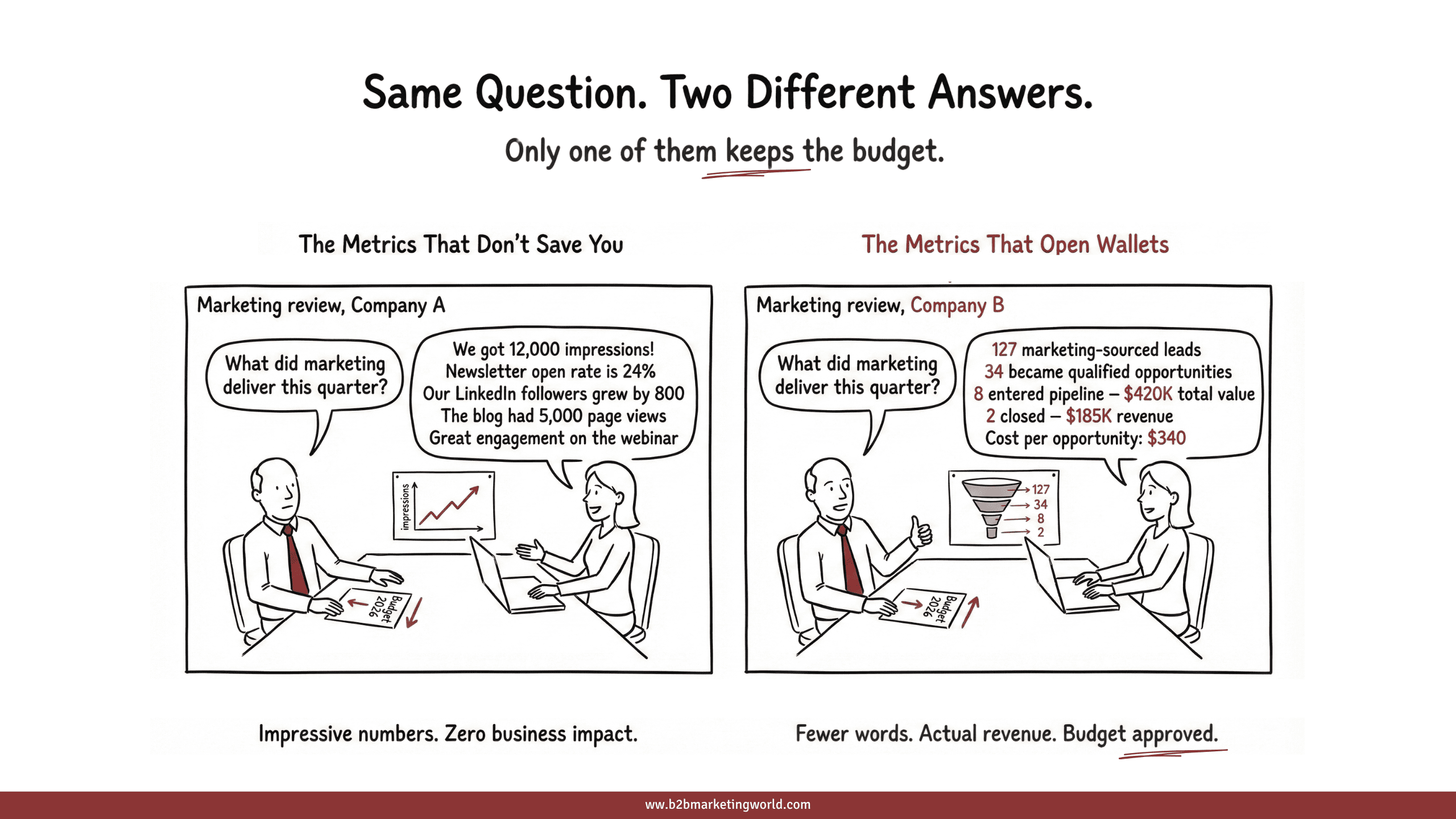
How to talk to top management to get logistics industry marketing budget © B2B Marketing World
The answer isn’t to fight for a bigger budget. It’s to make the current budget visibly accountable. Every campaign tied to pipeline. Every trade show measured beyond “we had great conversations.” A well-structured B2B marketing funnel makes this measurable.
Most logistics marketing teams can’t answer a simple question: “What revenue did marketing contribute last quarter?” If you can, you don’t have a budget problem. You have a credibility advantage.
Don’t overlook retention and expansion marketing. Multi-year contracts are common. The clients you already have are your highest-value audience, and almost nobody markets to them well. This is where B2B growth marketing — with its focus on both acquisition and retention — becomes essential.
Here are 3 more aspects to consider:
The Marketing Channels That Actually Work
How to Stop Wasting Budget on the Wrong Ones
Strategy without channels is just a slide deck. Not every channel works equally in logistics, and the difference between “we’re doing LinkedIn” and “LinkedIn actually generates pipeline” is bigger than most teams realize.
Here are 6 Channels:
If your channel strategy still looks like this, it’s time to move on…
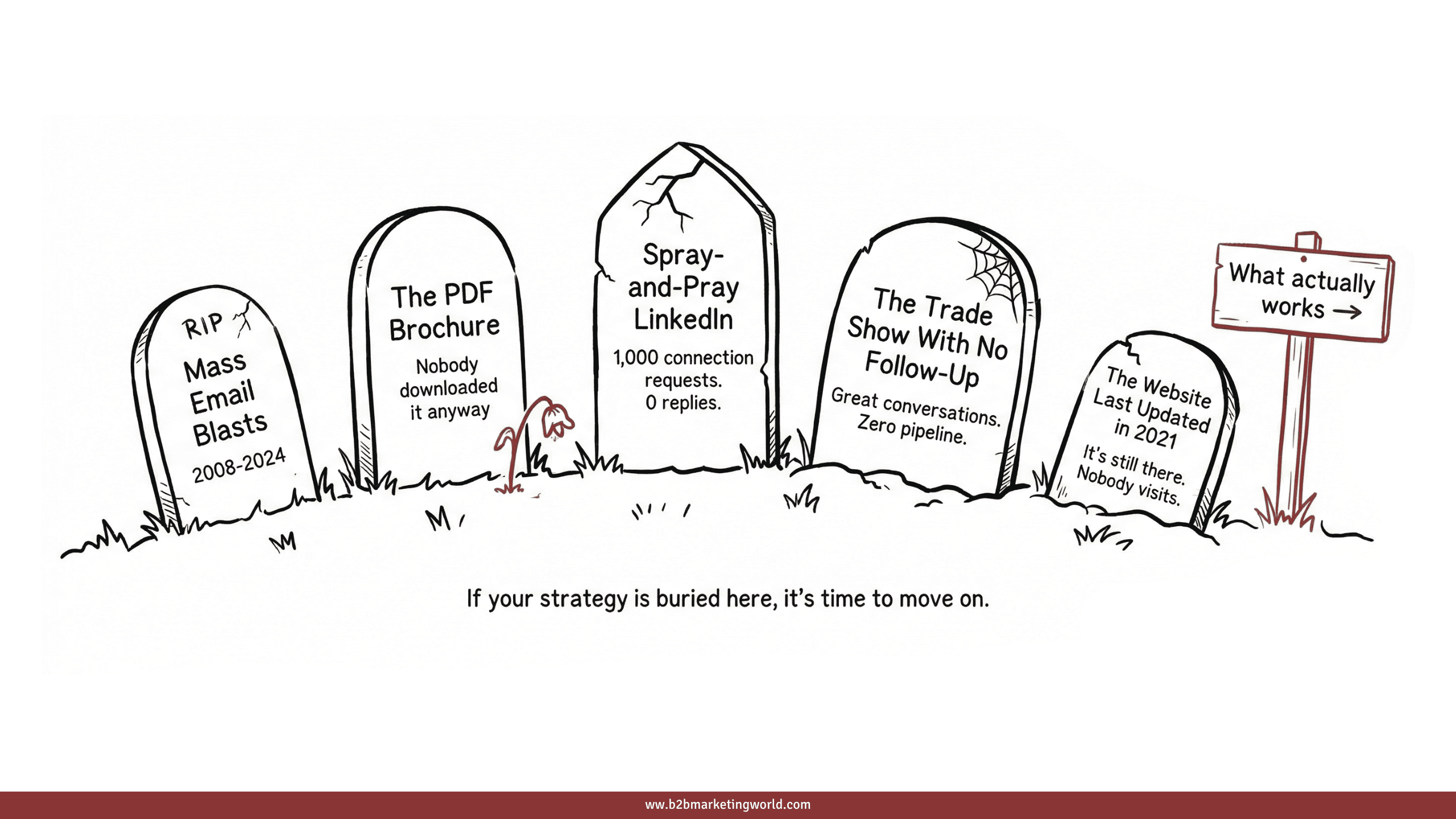
The graveyard of classic B2B logistics industry marketing © B2B Marketing World
Digital Marketing: The Backbone You Can’t Afford to Get Wrong
80% of the buying journey happens before a buyer contacts you (Gartner). That journey is digital. If you’re not visible, you don’t exist in the consideration set.
Digital marketing in logistics isn’t a channel. It’s the infrastructure everything else runs on. Without it, your trade show investment, your ABM play, your outbound efforts all lose their multiplier.
Get the basics right first: a website that communicates what you do and for whom. Content that answers buyer questions. A consistent presence where your buyers spend time. For a deeper dive, explore this guide on digital B2B marketing.
Pro
- Reaches buyers during the 80% of the journey before first contact
- Compounds over time: every piece of content builds long-term visibility
- Measurable and adjustable
Con
- Takes 6-12 months before organic efforts generate real pipeline
- Easy to do poorly: weak content actively hurts credibility
LinkedIn is the primary B2B channel for logistics. Thought leadership, targeted ads, and decision-maker outreach converge here. Your buyers evaluate your credibility on this platform before they ever visit your website.
What works: thought leadership from real people (not just the company page), targeted ads to specific job titles, and direct outreach that adds value before asking for anything. Track what’s working with a free LinkedIn dashboard to measure your performance.
Pro
- Direct access to decision-makers by job title, company, and industry
- Personal thought leadership builds credibility fast
- Low cost compared to events or traditional advertising
Con
- Organic reach declining: pay-to-play increasingly necessary
- Generic posts get ignored: strategy required, not just presence
SEO and Content Marketing
Logistics buyers research topics like “how to choose a 3PL partner” or “supply chain risk management” before they talk to anyone. If your content answers those questions, you earn trust at the exact moment they’re forming their shortlist. That’s high-intent traffic you can’t buy with ads.
LinkedIn drives short-term visibility. SEO compounds over months and years. Together, they create a system where buyers find you, recognize you, and trust you before sales ever makes contact. Learn how to build this system with a proper B2B content marketing strategy.
Pro
- Captures high-intent buyers at the moment they’re actively researching
- Compounds: a good article today still generates leads 2 years from now
Con
- Slow: 6-12 months of consistent publishing before meaningful results
- Competitive for broad terms: smaller companies must pick specific niches
Email Marketing
Email works in logistics. But only when segmented and intent-triggered. In an industry where trust is the currency, mass blasts don’t just underperform. They actively damage your credibility. Effective email is part of a broader lead management process.
Pro
- Direct line to opted-in prospects: highest conversion potential per contact
- Low cost, highly measurable
Con
- Mass blasting destroys credibility fast in a trust-first industry
- Requires good data and segmentation to work at all
- Inbox competition brutal: generic subject lines get deleted unread
Trade Events and Conferences
Trade shows still matter. Relationships are built in person. Deals move forward over dinner. But most companies treat events as standalone activities: book a booth, collect cards, come home. That’s why pipeline impact is minimal.
Events work when you treat them as campaigns with 3 phases:
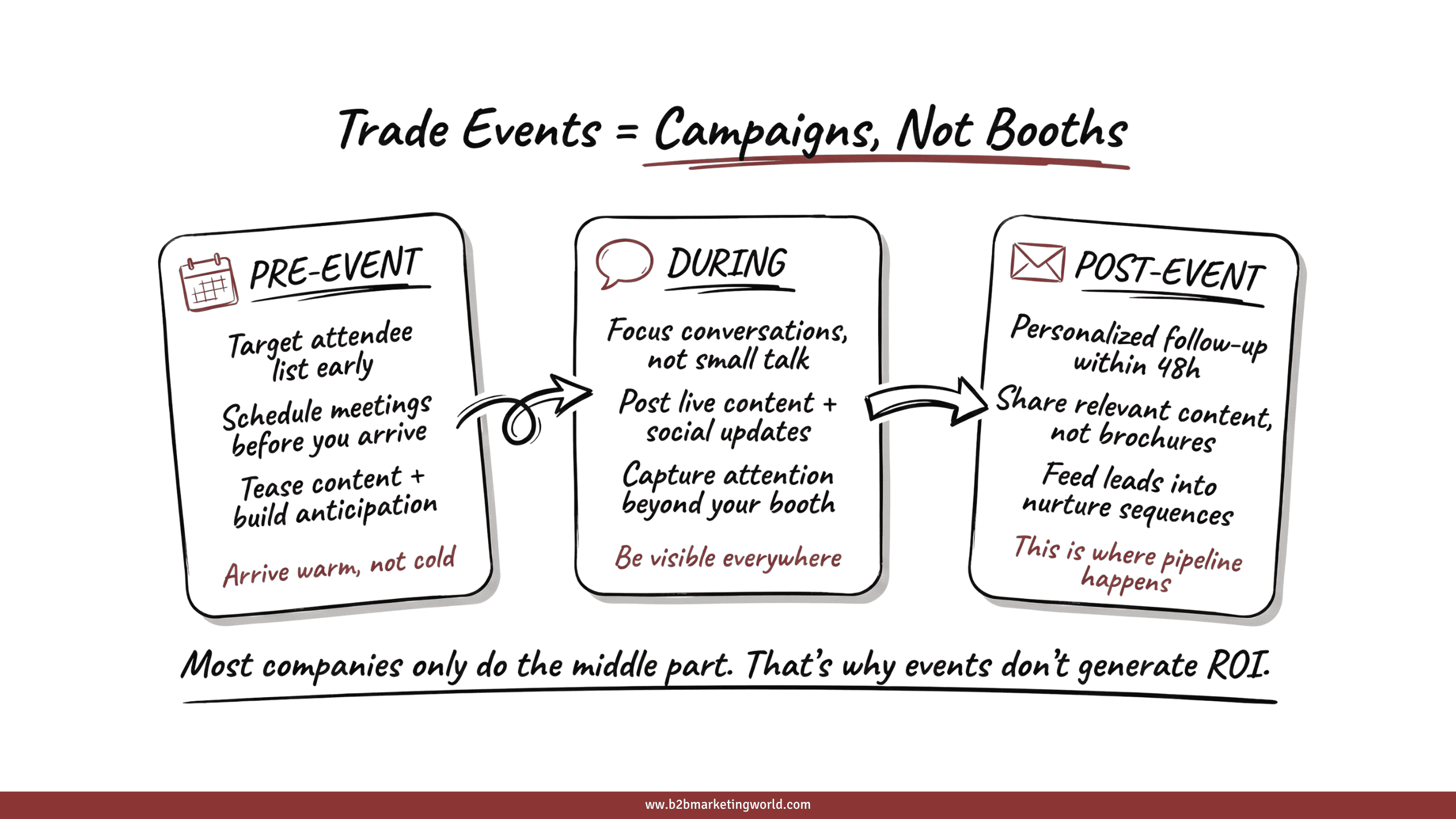
3 Event Phases during a Logistics Industry Marketing Trade Event © B2B Marketing World
Pro
- Face-to-face trust-building is unmatched in a relationship-driven industry
- Concentrates decision-makers in one place
Con
- Expensive: booth, travel, staff time add up fast
- Without pre/post structure, ROI nearly impossible to measure
- Easy to confuse “busy booth” with “pipeline generated”
Account-Based Marketing (ABM)
For enterprise accounts with long cycles and multiple decision-makers, ABM aligns marketing and sales around the same target list with personalized content and coordinated outreach.
Start simple. Top 20 accounts. Content for their specific challenges. Coordination with sales on timing. Measure at the account level, not the lead level. ABM works best when paired with a broader demand generation strategy that feeds the pipeline.
Pro
- Focuses resources on accounts most likely to close
- Aligns marketing and sales on same list, same message
- Personalization cuts through noise mass marketing can’t
Con
- Requires sales-marketing alignment most logistics companies don’t have yet
- Small lists mean slow pipeline: not a volume play
Your Logistics Marketing Starting Point for 2026
You’ve made it through the strategy, the channels, the examples. The question that matters now: where do you actually start?
Not with everything.
That’s the mistake most logistics indsutry marketing teams make. They read an article like this, get motivated, and try to launch LinkedIn, SEO, ABM, email nurturing, and a trade show campaign all at once. With 2 people. That doesn’t work. It leads to 5 mediocre efforts instead of 1 good one.
Start with your foundation. Then add layers.
If you have a small team (1-3 people), here’s a realistic prioritization:
- 1
Website + core content
If buyers can’t find you or understand you online, nothing else matters - 2
LinkedIn (personal + company)
Fastest channel to build visibility and credibility with decision-makers
- 3
1-2 trade events with full campaign structure
High-impact for relationship-building, but only with pre/during/post execution - 4
Email nurturing for existing contacts
Low cost, high impact: your existing network is your warmest audience - 5
ABM for top 10-20 accounts
Add this when foundation is solid and sales alignment exists
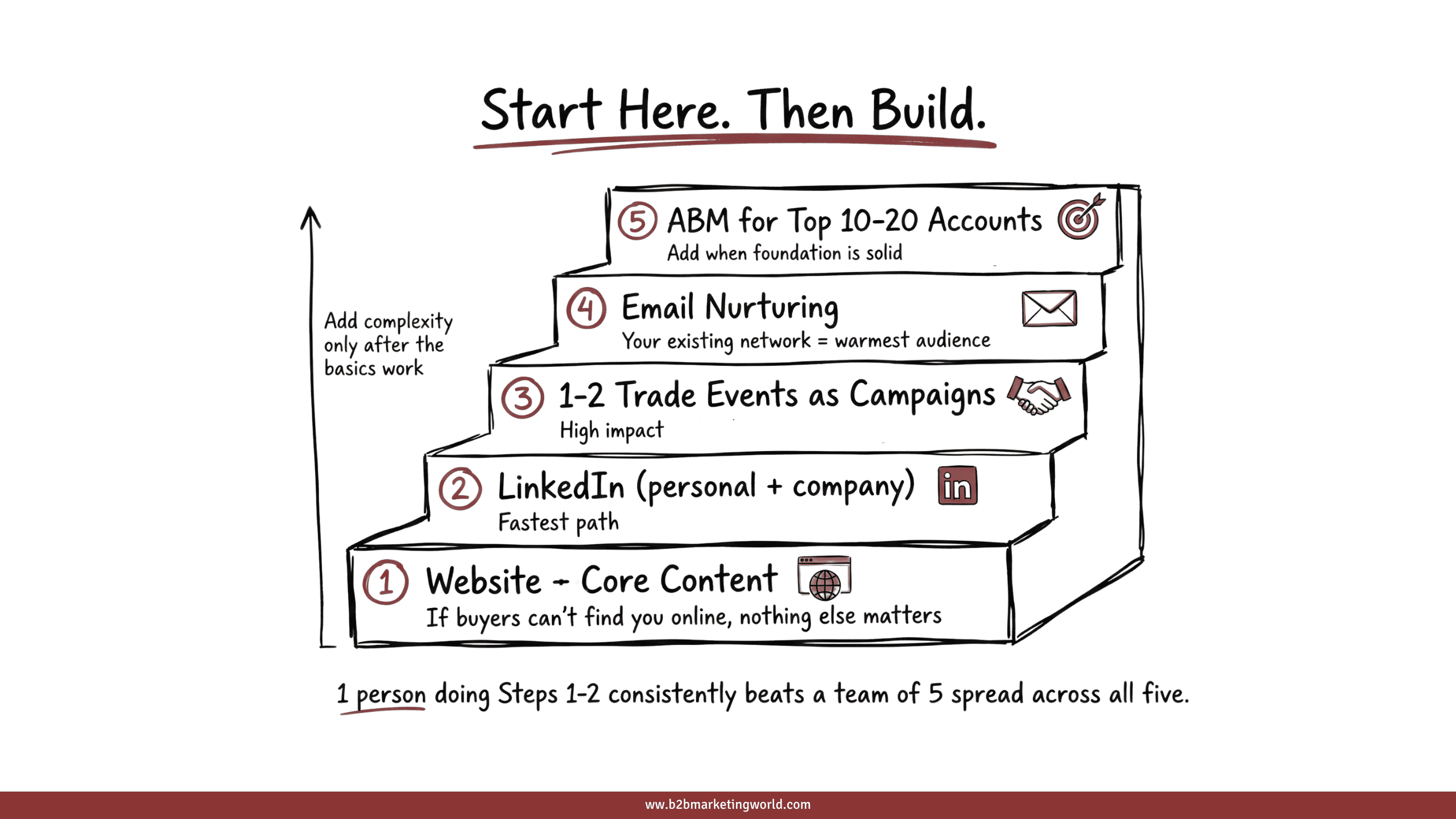
The Priority Staircase in B2B Logistics Marketing © B2B Marketing World
If you have a larger team (4-8 people), you can run priorities 1-3 in parallel and add SEO as a dedicated long-term investment from day one.
ABM become realistic additions, not aspirations.
Need a structured starting point? Use a free B2B marketing plan template to translate priorities into action, or browse all available B2B marketing templates for content calendars, prioritization matrices, and more.
And here’s the part nobody talks about: the real resource problem in logistics marketing isn’t headcount. It’s internal credibility. If your C-suite still sees marketing as the team that makes brochures, no amount of tactical excellence will save you. Demonstrating ROI from your first focused efforts is how you earn the budget and trust for everything that comes after. Start small, prove impact, then expand.
Which brings us back to where we started. Maersk didn’t become a B2B marketing case study by doing everything. They did one thing boldly: they made the buyer the hero. That single idea changed how the market perceived them.
You don’t need Maersk’s budget. You need their clarity.
Pick your starting point. Execute it well. Measure it honestly. Then build from there.
Logistics industry marketing is hard. The buying cycles are long, the budgets are thin, the industry still treats marketing as an afterthought. But that’s exactly why the companies that commit to it now win disproportionately. Because most of your competitors won’t.
You’re reading this article. They’re not. That’s already a head start.
Summary [TL;DR]
Logistics Industry Marketing in a Nutshell
The problem: Logistics feels like a commodity. Most companies compete on price, routes, and reliability claims. B2B marketing is underfunded, understaffed, and treated as sales support. Meanwhile, buyers complete 80% of their research before they ever talk to you (Gartner).
The proof it can be different: Maersk’s “From Chaos to Hero” campaign didn’t talk about shipping routes. It made the logistics professional the hero. It won awards and repositioned the brand. The principle works at any budget: stop marketing like everyone else.
What buyers actually care about: Reliability beats price, but only if you can prove it before the first call. Switching costs are high, so your marketing needs to reduce perceived risk, not just list features. Buying committees are multigenerational and expect digital-first engagement.
The 2025-2026 shift: Tariffs, AI, and thin margins are changing the playbook (PYMNTS Intelligence). Marketing must speak to business outcomes, not features. Proving ROI to leadership is a survival skill. Generic outbound is dying. ABM, video, and offline/hybrid tactics are gaining ground.
The channels that work: – Digital marketing is the foundation, not optional – LinkedIn for visibility and credibility with decision-makers – SEO and content for long-term, high-intent pipeline – Trade events as campaigns (pre/during/post), not just booths – ABM for enterprise accounts with long sales cycles – Geofencing and direct mail as under-utilized, high-impact additions
Where to start: Not with everything. Website and content first. LinkedIn second. One or two trade events with real campaign structure third. Prove ROI early, earn internal credibility, then expand.
The bottom line: Logistics industry marketing is hard. That’s exactly why it works for the companies that commit to it. Most of your competitors won’t.

Stephan Wenger
B2B Marketing Expert, Editor and Marketing Management Consultant
Stephan Wenger is a seasoned B2B Marketing Expert with more than 15 years of experience in leading global companies. His extensive expertise lies in the realms of B2B online marketing, content marketing, strategic marketing, and driving synergy between sales and marketing, including effective lead management.
You May Like the Following Articles

Life Sciences Marketing
Life sciences marketing is brokenecause the standard B2B playbook was never built for an audience that peer-reviews your claims before reading your second paragraph. This article breaks down why life sciences marketing plays by different rules and which channels actually earn trust with scientific buyers.
Semiconductor Marketing
Why semiconductor companies struggle to market, how most semiconductor marketers are fighting with one-person teams. This article shows you how: the five structural barriers to fix first, the channels that influence decisions, a framework for marketing around the design-win model, and a ready-to-adapt campaign blueprint.
Steel Supplier Marketing
This article reframes steel marketing as a decision-support system. See how early signals shape shortlists, how different buying roles rely on marketing to reduce risk, where common approaches fail, and what changes when marketing is built to support approvals instead of attention.
B2B Agricultural Machinery Marketing
Selling tractors, harvesters, or plows isn’t a quick process. Buyers take time, involve multiple decision-makers, and require a solid financial commitment. This is a full guide on B2B agricultural machinery marketing, including real-world examples from John Deere and Kubota.
B2B Construction Machinery Marketing
This is your guide to create a B2B marketing construction machinery roadmap + 3 Examples. Marketing in the construction machinery industry is complex but essential. Unlike consumer goods, purchasing decisions for heavy equipment like excavators, bulldozers, and loaders involve multiple stakeholders, long sales cycles and significant investments. This article provides a structured approach to B2B marketing for the construction machinery industry.
B2B Fintech Marketing
B2B fintech marketing promotes financial technology products to other businesses. It’s different from consumer marketing because the target group is companies like banks, insurance firms, and financial institutions. In this article, we explore the foundations of B2B fintech marketing. We look at key strategies, challenges, and how to measure success. We also discuss future trends that will shape this industry.
B2B Manufacturing Marketing
B2B manufacturing marketing involves promoting products and services from one business to another within the manufacturing sector. Key Points are: Complex Buying Process, Emphasis on Relationships, Technical Focus. This blog post will explore the unique aspects of B2B manufacturing marketing, its challenges, and effective strategies for overcoming them.